| about us |
what's new
|
unit studies
|
unit study helps |
hss resources
|
fiar resources | indexes | lapbooking |
Chicken Man
| Author: Michelle Edwards ISBN: Summary: A heart-warming story about an Israeli who lives on a kibbutz |
Literature Based Unit Study Written by Jeana
(I have tried and tried without success to e-mail this unit study writer.
If anyone has more information on her, please let me know. I am moving her
unit to HSS just in case the website that is hosting it ever disappears.)
SOCIAL STUDIES: MAP SKILLS
Take a closer look at the map in front of the book. Find the Chicken Man’s
house in relation to the other buildings. Trace with your finger the route he
would take to get to his first job (the chicken coop), his second job (laundry),
etc.
Using Monopoly ™ houses and hotels or Lego ™ blocks, make a model of the
kibbutz. Let your child give and follow directions by looking at the map. E.g.
The house goes to the right; the dairy is to the north, etc. Label each
building.
Make a map and/or model of your own neighborhood.
SOCIAL STUDIES: CULTURE
Explain how a kibbutz works and wonder about what it would be like to live
on a kibbutz.
Pretend your house is a kibbutz and set up and assign jobs and areas to
child(ren). Ring a bell or some other signal when it’s time to change jobs.
Everyone rotates. Some jobs could be real; some could be silly – like scrub
floor with toothbrush or build a house with toothpicks. Encourage good attitudes
and “whistling or singing while you work” At the end ask which jobs were most
enjoyable.
SOCIAL STUDIES: RELATIONSHIPS
Discuss working together without being jealous and without fighting; discuss the
process of making an appeal to leadership – when Chicken Man went to Simon and
said, “We need to have a meeting.” He didn’t begin complaining to others, but he
went to the proper authorities to discuss the problem. Give child a problem –
e.g. she is given a book to read at a friend’s house that she would not be
allowed to read at home. Have her act out the proper appeal process.
SOCIAL STUDIES: GEOGRAPHY
This story takes place in Israel. Find Israel on the map. What other countries
border Israel to the North, South, East and West? Find the Jezreel valley.
Compare ancient Israel with modern Israel (most Bibles have maps of ancient
Israel). Jezreel is mentioned in the Bible in Joshua 17:16. Make your own story
disk to place on Israel.
Israel Flag Minit Book
Israel's Flag
Outline Map of Israel
BIBLE
This reminds me of the story of Joseph in Genesis 37-47. Everywhere Joseph went,
he did well – even when he was in slavery he was promoted to the highest
position. His brothers were jealous of him. Talk about correct responses when
others are promoted. The Bible says to “Rejoice with those who do rejoice.” (1
Corinthians 12:26) How can we share in others’ success; e.g. when your brother
or sister gets something special?
Discuss: Why were the children so misbehaved? “A child left to himself brings
shame to his mother.” (Proverbs 29:15)
Character: Chicken Man was diligent – he worked hard and even did extra things
that weren’t required; i.e. fixing the sprinkler system, bringing Clara roses.
His willingness to work hard paid off; he eventually got the job he wanted
permanently. Diligence: 2 Peter 1:5-7; Proverbs 27:23-27; Proverbs 28: 20;
Proverbs 10:4; Proverbs 21:5; Proverbs 4:23; Luke 15:8; Romans 12:8
FOREIGN LANGUAGE
Have fun learning some Hebrew words:
Shalom = peace, also hello and good bye
of = chicken
beytzim = egg
charutz (pronounced a guttural h sound, not ch) =
diligence
LANGUAGE ARTS: VOCABULARY/SPELLING
Draw pictures of the nouns (things). Act out the verbs (action words). Review
words frequently. Use at the end of unit for spelling test.
Brood – a group, usually a family of offspring hatched at one time
Chicken – a domestic fowl
Cluck(ing) – the sound a hen makes
Combs – the fleshy outgrowth on the head of certain roosters
Coop – a cage in which chickens are penned
Committee – a group of people elected to perform some service or function
Crow(ed)– the cry of a rooster
Gardener – a person who takes care of the garden
Kibbutz – a community settlement (Israeli)
Machine – something that is used to do work
Muck(ed) – to remove manure
Mulch(ed) – to cover with straw
Orchard – a group of fruit or nut trees
Strut, strutted – to walk proudly
LANGUAGE ARTS: CRITICAL THINKING SKILLS
Why do you suppose the workers were required to change jobs every so often? Do
you think they made the right decision at the end to leave Chicken Man in the
chicken coop? Do you think the other workers were happy about this? Why or why
not? Create a “chores graph” for your household. Assign everyone a task for a
certain amount of time and post in a central place.
LANGUAGE ARTS: POETRY
Write a poem from Clara’s perspective begging the Chicken Man to come back
to the coop.
OR Write a story about your day visiting a kibbutz.
LANGUAGE ARTS: IDIOMS
This story illustrates these idioms even though they are not spoken in the
story itself.
Idioms/sayings to discuss: “The grass is always greener on the other side of the
hill” – each person who was not satisfied with his/her job, thought s/he would
be happier if s/he had a different job.
“Whistle while you work” – being happy makes the job more enjoyable.
“A little bird told me.” On the page where the work committee is gathered
discussing the problem, a bird is sitting in the window “listening.” This comes
from the Bible – Ecclesiastes 10:20 “Do not curse the king, even in your
thought; Do not curse the rich, even in your bedroom; For a bird of the air may
carry your voice, And a bird in flight may tell the matter.” (Could also be used
for Bible discussion)
MUSIC: HEBREW, BLUES, AND FOLK SONGS
Chicken Man sings while he works. This is one of the reasons the chickens
like him so much. The books list different kinds of songs that he sings. Make a
list of the different kinds of songs we sing: folk songs, nursery rhymes, church
songs, etc. Folk songs are ones that have been handed down from one generation
to the next. Folk music was not written down, but learned by rote. Most of the
songs have unknown authors. They often tell a bit of history or culture.
Sing some American folk songs: Yankee Doodle, Pop Goes the Weasel, Blow the Man
Down, Old Joe Clark, Swanee River.
Try learning some Hebrew folk songs: Shalom Chaverim and Henei Ma Tov speak of
unity and peace. (I found them in The Music Book series)
Also you could discuss how music has been used throughout history to “soothe”
the soul when a situation was undesirable – e.g. slaves worked in rhythm and
sang what is now called the blues. Learn some blues tunes or basic blues form:
each stanza has three lines; the second is a repetition of the first. Each line
of words makes up four measures, for a total of twelve measures. The three
primary chords are used (I, IV and V) – four measures of I, two measures of IV,
two measures of I, two measures of V, and two measures of I. If you are
musically inclined, try making up your own blues tune following these
guidelines.
ART: CARTOONING
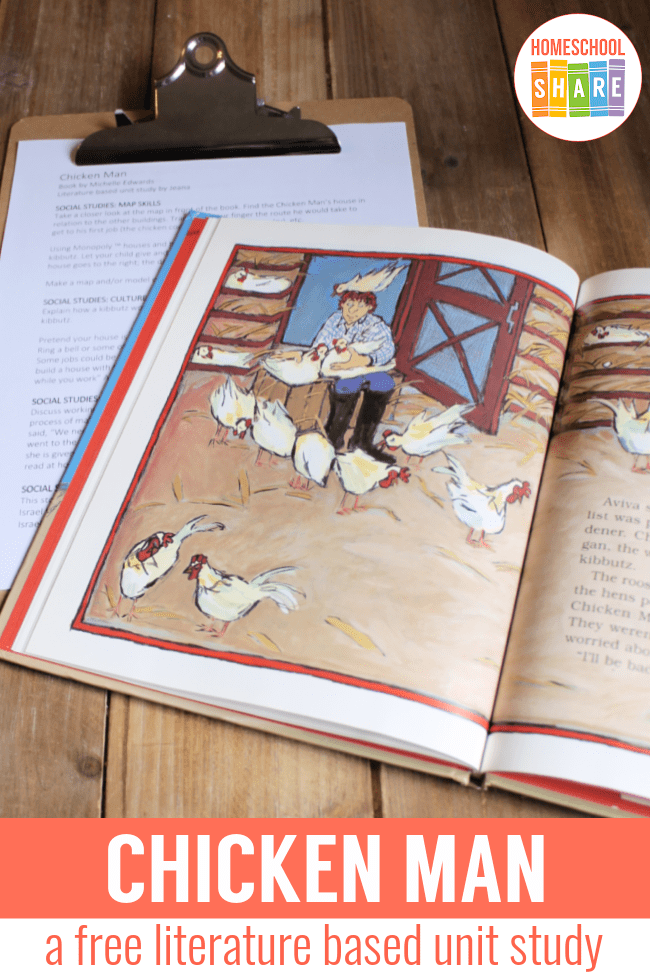
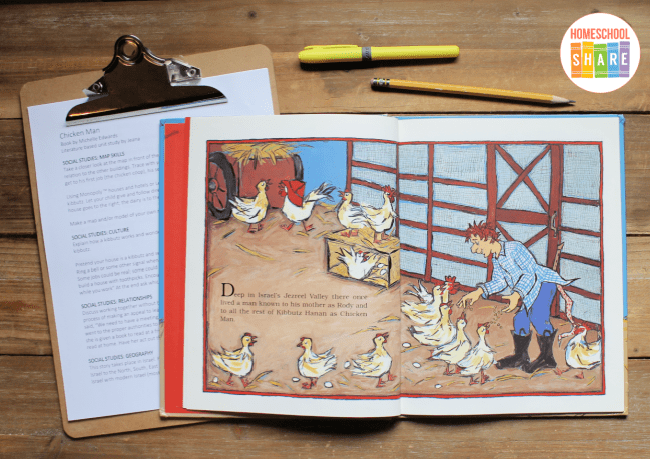
Consider the cartoon-like illustrations in this book. Try drawing some cartoons
of your own. A great book is Cartooning for Young Children by Vic Lockman,
(Westminster Teaching Materials 233 Rogue River Hwy #360 Grants Pass, OR 97527.)
Does chicken man look happy in the drawings? Try drawing happy characters. Look
at some of the other characters. Do they look happy? Try expressing particular
feelings through cartoon faces; e.g. sad, angry, surprised, afraid.
MATH: COUNTING AND SKIP COUNTING
Count the chicken and/or the eggs. Find out how many eggs there would be if
each chicken laid two eggs, three eggs, four eggs, etc. Count by twos, threes,
fours, and fives. Make a chart that shows this:
If you had 10 chickens and each one lays
2 eggs 3 eggs 4 eggs 5 eggs
How many would you have?
MATH: ESTIMATING AND MULTIPLYING
The children were unrolling roles of toilet paper to see if it would really
stretch to Tel Aviv. Find out how far it is on the map from the Jezreel Valley
to Tel Aviv (approximately 40 miles) Estimate how much toilet paper it would
take to stretch all the way there. A mile is equal to 5,280 feet or 1760 yards.
Look on a package of toilet paper to figure this out. We had to multiply each
square (4.5”) by the number of squares in a roll (280); take that number (1260”)
and divide it into feet (1260” / 12” = 105’); then divide that number into 5,280
(50.3). This should be the number of rolls for one mile. Multiply that number by
40 (2012). This number tells how many rolls it would take to stretch across 40
miles.
SCIENCE: BIOLOGY –CHICKENS
Learn more about chicken and eggs. How long does it take an egg to hatch? How
many eggs does a chicken usually lay each day? Are they temperamental? Would
they be “sad” if someone like Chicken Man was not there and actually refuse to
lay eggs? Contact a farmer in your area and ask some questions. Your local
health food store should be able to put you in contact with a local farmer who
sells brown eggs; perhaps you can purchase some eggs from him and observe the
chickens. Observe pecking order.
SCIENCE: GARDENING
Talk about the hard work involved in taking care of garden – weeding, mulching,
and trimming. Act these things out. Or plant flowers and have a little garden or
your own. Go outside and observe the different parts of a flower (stem, petals,
leaves, stamen, and sepal).
JUST FOR FUN
P.E./GAMES:
If you have enough people in your family, play volleyball and rotate positions.
Perhaps you could play with another family, and make it even more fun. Simple
version: two or four square (rotate to different squares)
Try juggling three balls or plastic Easter eggs. A great book is Juggling for
the Complete Klutz by John Cassidy.
COOKING
Make pancakes and try flipping them in the air. Or experiment with making
cookies with and without eggs. First hypothesize about what will happen. Chart
the results. What happens to the cookies without the eggs? How do they taste? Do
they fall apart? Which are easier to work with?
Materials and information on this website belong to the original composers. It may be used for your own personal and school use.
Material may not be used for resale. © 2005-07 HSS