Affiliate Disclaimer
We sometimes use affiliate links in our content. This won’t cost you anything, but it helps us to keep the site running. Thanks for your support.
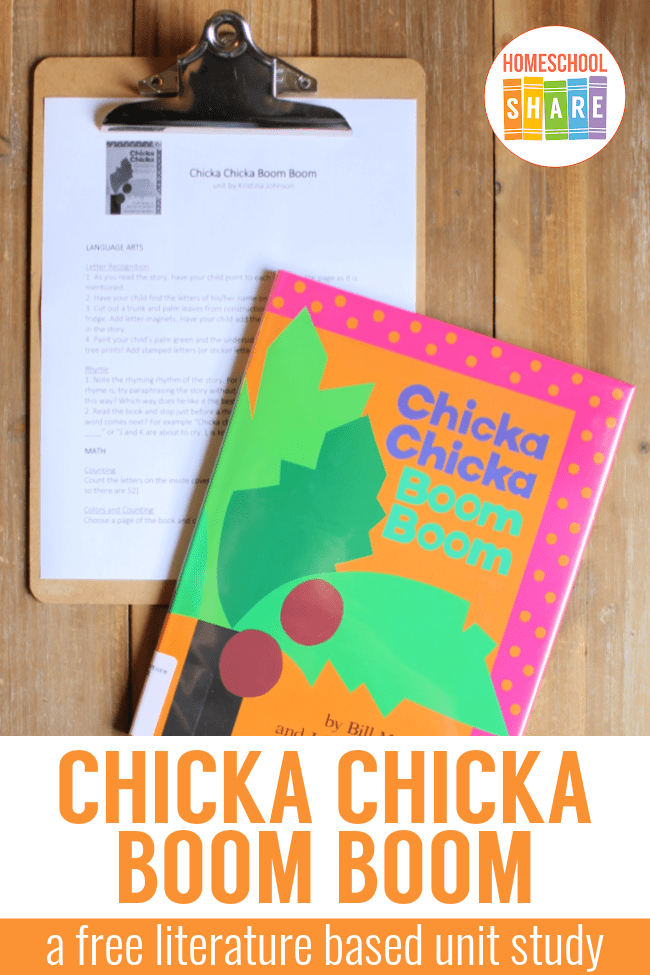
These Chicka Chicka Boom Boom activities are a great way to introduce your toddler or preschool students to the alphabet.
A told B
and B told C,
“I’ll meet you at the top
of the coconut tree.”
The letters race to the top of the tree, but will there be enough room? Children love the rhythm and rhyme of this classic story.
Thanks to Kristina Johnson for preparing this Chicka Chicka Boom Boom unit study.
Chicka Chicka Boom Boom Pre-Reading Activities
Letter Recognition
1. As you read Chicka Chicka Boom Boom, have your child point to each letter on the page as it is mentioned.
2. Have your child find the letters of his/her name on the inside front cover.
3. Cut out a trunk and palm leaves from construction paper. Tape the tree to the fridge. Add letter magnets. Have your child add the letters as they are mentioned in the story.
4. Paint your child’s palm green and the underside of her arm brown. Make palm tree prints! Add stamped letters (or sticker letters . . . or pasta letters).
Rhyme
1. Note the rhyming rhythm of the story. For your student who understands what rhyme is, try paraphrasing the story without the rhyming. Does your child enjoy it this way? Which way does he like it the best?
2. Read the book and stop just before a rhyming word. Can your child guess what word comes next? For example “Chicka chicka boom boom! Look there’s a full ____” or “J and K are about to cry. L is knotted like a _____”.
Chicka Chicka Boom Boom Math Activities
Counting
Count the letters on the inside cover (there are both upper and lower case letters, so there are 52)
Colors and Counting
Choose a page of the book and count how many red, orange, pink, green, blue, and yellow letters there are. Have your child color a bar graph. Are there more green than blue? Which color has the most letters? Which has the least?
Patterns
Have your child follow a pattern with cut out letters. A, B, C, A, B, (what comes next?) You might also consider cutting the letters out of various colors. Red A, Blue A, Red B, (what comes next)
Measurement: Weight
Use magnetic letters on a balance. What happens if the same amount of letters is placed on each side? How many can the child place on one side before it tips?
Chicka Chicka Boom Boom Cooking Activities
Coconut
Try adding coconut to your favorite granola recipe or sprinkling it on oatmeal, cold cereal or fruit salad. You could also look for some simple coconut recipes to prepare with your student.
ABC kabobs
Slice apples, bananas, and carambola (star fruit) into bite size pieces. Let your child thread them onto skewers. It is fun to put a star fruit slice on the end to create a “magic” wand.
Fruit Smoothies
Let your child choose one or two tropical fruits. Add chunks (equal to 1-2 cups) to blender with one can of mandarin oranges (with juice) and one banana. Blend. Add ½ cup or more of milk to desired consistency. Note: freezing the banana ahead of time adds to the texture.
Chicka Chicka Boom Boom Family Tree Activity
Family Tree
Discuss with your child extended family roles such as aunts and uncles and cousins. Make a family tree with the child’s grandparents at the top.
Chicka Chicka Boom Boom Science Activities
Day and Night
Discuss the rotation of the earth and the concept of day and night. An easy way to do this is to place a paper doll shape on the globe. Shine a flashlight (sun) onto the globe where the figure is. Slowly rotate the globe and notice that the figure slowly moves out of the sunshine (into the night).
Coconut Trees and Tropical Climates
Have your child look at the tree in the book. Does this look like the trees in your yard? Coconut Palm Trees grow in tropical climates. Tropical climates are categorized by high temperatures and large amounts of precipitation year round. Discuss with your child differences and similarities between this type of climate and your own. Use a calendar to note how many sunny and rainy days you have over the next month or two. You might also wish to set up a rain gauge in your yard.
Fruits
After your trip to the local grocery store (see Life Skills), let your child smell and touch the various fruits that you have chosen. What is the texture? Is it smooth or rough? Can your child find the stem end? What is the shape? Let your child help you to wash the fruit. Then, wash his/her own hands. Cut each one open (for information on how to open a fresh coconut, see below) and examine the flesh and seeds. Is there juice? Is the flesh of the fruit a different color than the skin or shell? Does it smell different after you have opened it? You may wish to save some of the various seeds and let them dry. You can plant them to see which (if any) will sprout.
Note: To open a coconut, puncture each of the eyes with a skewer or nail. Then allow the coconut to drain. Put the coconut into a large Ziploc bag. Place on a hard surface (the driveway works well) and whack it with a hammer.
Chicka Chicka Boom Boom Life Skills Activities
Grocery Store Field Trip
Bananas, citrus fruits, and pineapple are tropical fruits that most young children regularly enjoy. Take a trip to the produce section of a local grocery store to explore other tropical fruits that are widely available at most grocery stores now. Select several new fruits to try. Let your child touch and smell the various choices. Some choices to consider include papaya, guava, mango, fresh pineapple, kiwi, star fruit (carambola), avocado, pomegranate, plantains, and be sure to also get a whole coconut! Take time to explain to your child how you choose each fruit, or ask the produce manager to assist you. You may want to call ahead to arrange this.
First Aid
All the letters crashed out of the tree and had some cuts and scrapes. Discuss how to treat a skinned knee or a stubbed toe.
Chicka Chicka Boom Boom Art Activities
Art Appreciation
Notice the bright colors that the illustrator chose. Point out to your child the polka dot border. Why does he/she think the artist chose to do that? How many shades of green did the artist use? Is each leaf the same shape? If you have discussed personification, ask your child to look at the pictures to find examples of ways that the artist added human characteristics to the letters.
Collage
Lois Ehlert is known for her collage art. Give your child many brightly colored paper and scissors and let them create a collage. They may wish to create a coconut tree or perhaps their house or something else of their choosing.
Painting
Get banana leaves from the grocery store. Let your child place them on top of construction paper (dark colors work best). Leave in the sun for several hours. When you remove the leaves, you are left with the design your child created. You can also get a similar effect by taping construction paper leaves to the construction paper. Have your child paint over the top of the leaves. When dry, remove the leaves.
ABC Coconut Tree Pictures
Use the banana leaves to make prints (or cut sponges into leaf shapes similar to the book). Paint the underside of the leaf with paint and press onto paper. Use bottle tops to make circles (coconuts) and pieces of rectangular sponges (trunks) to complete their pictures. You can then add ABC stickers or use ABC sponges to complete the trees.
Chicka Chicka Boom Boom Additional Activities
Make a Grass Skirt
Use newspaper to make “grass” skirts for dress up fun. Open several thick sections of a newspaper and tape end to end to fit around your child’s waist. Tape a length of twine or yard to each end. Cut strips up from the bottom to within 2 inches of the top. Wrap around your child and tie at their waist. Play some hula music and enjoy dancing together.
Paper Towel Tube Trees
Paint paper towel tube brown. Cut leaves from construction paper and glue/tape to the top. Add coconuts (brown pom poms or circles of construction paper) to the leaves. You may wish to also add ABC stickers to the trunk and leaves.
Chicka Chicka Boom Boom Library List
Grab these other books and learn more about the alphabet.
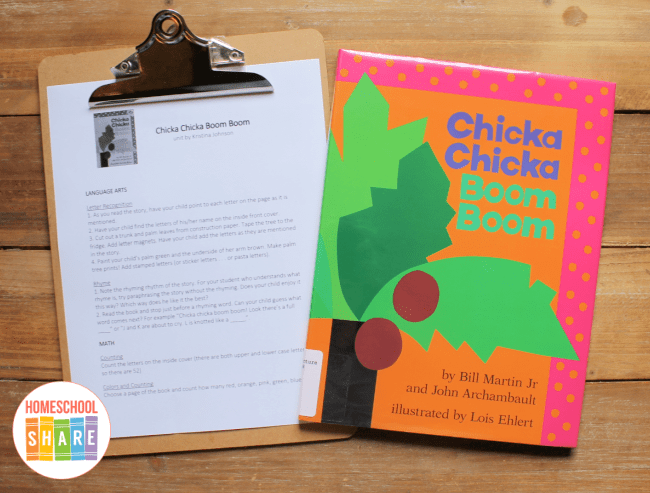
- Chicka Chicka Boom Boom by Bill Martin Jr. and John Archambault
- Dr. Seuss’ ABC
- On Market Street by Arnold Lobel
- Eating the Alphabet by Lois Ehlert
- Alphabet City by Stephen T. Johnson
- The Z Was Zapped by Chris Van Allsburg
Grab Your Free Chicka Chicka Boom Boom Unit Study
If you’d like a copy of this Chicka Chicka Boom Boom unit study in an easy-to-print file, click on the image below.
More Alphabet Themed Resources
If you are looking for more alphabet themed resources, try these: