| about us |
what's new
|
unit studies
|
unit study helps |
hss resources
|
fiar resources | indexes | lapbooking |
Call me Ahnighito
Author: Pam Conrad
Illustrated by Richard
Egielski
ISBN: 0060233222
Unit Study by Michelle Light, additional lessons contributed by Celia Hartmann
This unit may be best suited for 2nd grade+, but it is easily adapted for younger students. (Michelle did the study with a preschooler and a kindergartner. Celia did with a 3rd grader and a 1st grader.)
(Pronunciation note: Ahnighito = Ah na HEET oh)
Overview
The first picture book narrated by a meteorite from the award-winning creators of The Tub People. Based on the true story of the Peary expedition's discovery of this famous meteorite, Pam Conrad's latest gem is told from a distinctive point of view, and illustrated with museum-quality paintings by Caldecott winner Richard Egielski.
Site about the book and the meteorite. http://www.matthewhenson.com/meteorite.htm See page 1 and 2 .
Taken from the Authors Note: This meteor now sits in the American Museum of Natural History in New York City. Robert E. Peary, the first man to reach the North Pole headed the discovery team in 1894 and finally brought Ahnighito to New York in 1897. It was Peary’s 4 year old daughter, along on the mission with her mother who named the meteorite. According to some sources this was the name of the native Greenlander who had cared for her as a baby. Other sources say that Peary’s daughter was named Marie Ahnighito Peary. Agnighito being her middle name. resource http://www.arlingtoncemetery.net/josephin.htm
The world's largest island, Greenland is about 81% ice-capped. Vikings reached the island in the 10th century from Iceland; Danish colonization began in the 18th century and Greenland was made an integral part of Denmark in 1953. It joined the European Community (now the European Union) with Denmark in 1973 but withdrew in 1985 over a dispute over stringent fishing quotas. Greenland was granted self-government in 1979 by the Danish parliament. The law went into effect the following year. Denmark continues to exercise control of Greenland's foreign affairs.
Why "Greenland" ?
There is a story about the origin of Greenland's name. The first settler in Greenland, Erik the Red, is reported in old Icelandic sagas to have named the new country Greenland to attract other settlers there. Some historians, anyway, have claimed that due to climatical changes, weather in Greenland in the Middle Ages might have been much warmer than nowadays. Ivan Sache, 3 September 2001
Helpful Websites:
http://www.classbrain.com/art_cr/publish/greenland_geography.shtml
Visit this site for more great information and pictures.
http://www.greatestplaces.org/book_pages/greenland2.htm
Flag and Map:
Map of Greenland Hand draw the country of Greenland or print out a map at http://www.classbrain.com/art_cr/publish/greenland_color_map.shtml
Flag- for a printable coloring page of the flag. http://www.coloringcastle.com/flag_coloring_pages.html
Meaning of the Flag
The flag of Greenland, or Kalaallit Nunaat, celebrated its 10 anniversary in June 10, 1995. For this occasion, the Greenland Post Office, issued some stamps and a brochure explaining the flag. The text in the brochure is written by Thue Christiansen, the flag's designer. Christiansen makes some remarks about the natural features of Greenland, and then goes on to account for the symbolism of the flag:
"the large white part in the flag symbolizes the ice cap and our fjords are represented by the red part in the circle. The white part of the circle symbolizes the ice bergs and the pack ice, and the large red part in the flag represents the ocean."
In other interpretations the circle is seen as representing the rising and setting sun.
Social Studies
The population of Greenland is predominantly Inuit, a people bearing an affinity and solidarity with the Inuits of Canada, Alaska and Siberia. It is only 140 years since the last immigration from Canada took place. The Greenlandic people are few in number: 55,000 in an enormous country. Approx. 20 percent of the population was born outside Greenland.
Most native Greenlanders today are a mixture of Inuit and Dane. All Greenlanders are bilingual and speak Inuktitut (the official name of the Greenlandic language) and Danish.
Today fishing is the all-dominating trade and accounts for 95 percent of total exports, but in the hunter districts of the outer areas, the seal and whale catch is of great importance. It actually forms the stable existence for one fifth of the Greenlandic population. For millennia the philosophy has been to live at one with nature. The hunters live with nature and follow the natural seasons.
History -In South Greenland, ruins from the Norse (Viking) settlers 1,000 years ago are well preserved, including the ruins of the first Christian churches on the North America continent. The symbols of the ancient culture are still alive even in the larger towns. Many people build and use their own kayaks. You can see them in every harbor. The old drum dance is performed by a growing number of artists. The musical and theatrical life is largely based on myths and sagas conveyed in a modern form.
This story takes place in 1894-1897. Discuss the technology at that time. The first car had just been invented by Daimer and Benz in 1887 and planes had not yet been invented. Notice how people in New York are dressed. Men held on to their derbies (hats).
Social Studies -- Tools made from the
Meteorites: In the story,
Ahnighito complains of the snow people chipping away pieces of him. The
following information came from the
American Museum of Natural History:
Although iron meteorites are incredibly hard, the Inuit people successfully chipped off pieces of the fragment known as the Woman using hammerstones made of basalt. The iron was then used to make tools such as knives and harpoons.
When explorer Robert Peary located the Woman in 1894 with the help of an Inuit guide, some 10,000 hammerstones were scattered around the three-ton meteorite. Over the years, Inuit people had carried these basalt stones to the area from far away because the rocks found naturally around the Woman were too soft to break iron.
Few trees grow on the rugged arctic terrain of northwestern
Greenland, so the native Inuit population long made tools and weapons out of
such materials as walrus tusks and reindeer antlers. And until the
mid-1800s, the primary source of metal for their knives, harpoons and spear
points was iron from meteorites.
Social Studies/Cultures -- Arctic Life: Ahnighito refers to the Inuit People as the Snow People. This site has amazing pictures of the people, culture and the land. http://www.greenland-guide.dk/narsaq-foto/10-02.htm
Language Arts-Names: Read the authors note from the book if possible. Ask your child to come up with a name for the meteorite. Why did they choose this name?
Language Arts --
Personification/Anthropomorphism: If your student has studied
personification before, ask him if he remembers the word that means "to give
animals and things human characteristics." The rock, Ahnighito takes on a
human personality and has feelings and thoughts. If your student can read,
have him go through the text and tell you what sentences and words are used
to bring Ahnighito to life. Otherwise, go over some of the passages and
discuss with younger students.
You may wish to introduce anthropomorphism.
(Pronunciation: an thruh puh morf ism) It is the specific type of
personification used in this story. Anthropomorphism is when a writer
applies either animal or human qualities to an inanimate object. Rocks are
inanimate (not living). The author chose to tell the story from the rock's
point of view and to allow the rock to have feelings of being cold, lonely,
patient, frightened, weeping, etc. Have your student come up with a
paragraph that uses anthropomorphism.
Anthropomorphism at Wikipedia and at Dictionary.com.
Language Arts -- Story Writing or Narration: Have your child make up and illustrate their own story using personification. Example-Maybe about a pet rock in their backyard.
Language Arts -- Legends: The Inuit People had legends (make believe stories) about the meteor-saying it was a sewing woman and her dog that fell from heaven. Have your child make up a story about why the meteor fell to earth.
Language Arts -- Writing: Has your child ever seen a falling star? What do people do with falling stars? (Wish) Do they think people saw this star and made a wish upon it? Make up and illustrate a story about some people that saw the star long ago and the wishes they might have made. We are not sure if people were around at the time this meteor hit the earth.. It’s fun to think about it though. (See Science Activity-Young vs. Old Earth.)
Vocabulary:
Check for understanding. Could do either written or orally.
island, meteor, prodded, probed, grunting,
straining, abandoned, exposed, hydraulic jacks, stubborn, obstinate,
strained, sparked, blizzard, wept, mightily, soggy, greased, steadied,
winches, groaning, edged, gangplank, plunged, topple, streaked, eased, bulk,
plowing, bashing, ice floes, compass, savage, creaking, troubling,
uninterested, alongside, pressed, beneath, yachts, buoys, swaying, enormous,
gently, splendid, procession, glorious, displayed, admire, famous, dimmed,
bask.
Art: The note in the overview is from the promotion of the book-stating it was illustrated with museum-quality paintings by Caldecott winner Richard Egielski. Why would they call them museum quality paintings?
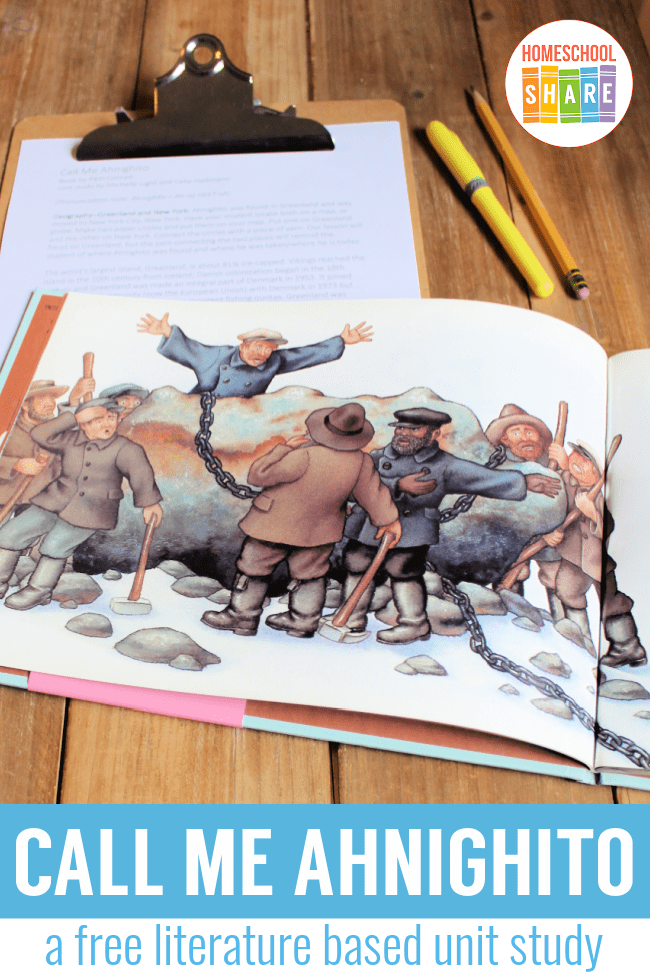
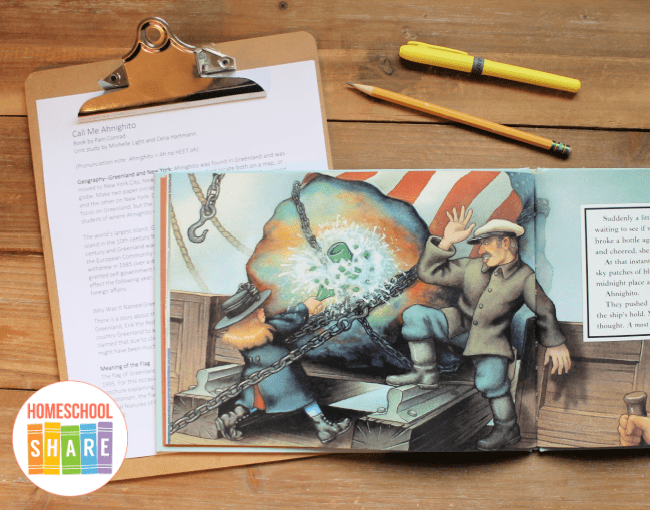
Art -- Facial Expressions: Notice the expressions on the people, the shadings in the rock, the ice illustrations, reflections of light in the water. Discuss the use of cool colors to make a cold feeling. Notice the pages in New York where warmer colors are used and the writer states that they were now in a warmer place.
Art -- Dioramas: Wikipedia states: A diorama is a partially three dimensional full-size replica or scale model of a landscape typically showing historical events, nature scenes, cityscapes, etc. for purposes of education or entertainment.
Lapbook activity: You could make a Four-Door Diorama and allow your child to make a small diorama similar to either the cover of the story or the page where Ahnighito is waiting the boat to return. For the proper fold technique, see page 48 of Dinah Zike's Big Book of Projects or page 40 of her book Big Book of Science.
Inuit Art - http://www.inuitarteskimoart.com/store/catalog/index.php
Art -- Drawing: Have your child draw the meteorite or any of the pages in the book adding their own imagination and creativity to it.
Math-- Tons / Metric Tons: The meteor weighs over 31 metric tons. Discuss metric ton and the English ton. How many pounds are in a ton? 2,000 In a metric ton? 2,205.
|
metric ton n. A unit of mass equal to 1,000 kilograms (2,205 pounds). So 2205 lbs x 31 =68,355.00 pounds |
Besides converting Ahnighito's weight from metric tons to pounds, make up other conversion problems.
Science - Meteors and Meteorites:
Many people do not
know the difference between a falling star, a meteor, and a meteorite...or
even if is there any difference.
A rock floating out
in space is called a
meteoroid.
When that rock
reaches the Earth's atmosphere, it begins to heat up and catch fire. It
then turns into a fireball called a
meteor.
(Point out the picture of the meteor on the front cover.) Another word for
meteor is a
falling "star."
As you just learned,
a falling star is not really a star that has fallen from it's place in the
sky, but a rock.
Most meteors you see
in the night sky burn up in the atmosphere and thus they never hit the
earth. Most of the meteors are very small...about the size of a pebble!
Every once in awhile, a larger rock will survive it's fiery descent and will
hit the earth. When it passes through the earth's atmosphere and hits the
earth, the rock is then called a
meteorite.
The outside of a
meteorite is melted because of the time it spent burning in the atmosphere.
Meteorites hit the earth with such force that they leave indentations in
the earth, called
craters. The
larger the meteorite, the larger the crater.
Many meteorites are
broken off bits of
asteroids and
are mostly made of iron and nickel. Asteroids are large rocks that orbit
around a star (like the Earth orbits around it's star the Sun, only
asteroids are much smaller than planets.)
Meteoroid breaking
Meteoroid in space
away from asteroid
Meteor burning Meteorite hits the earth
in atmosphere
Ahnighito was part of a larger meteor called Cape York, believed to have
been about 200 tons in size. (Six times the size of Ahnighito alone.)
The meteor broke up in the earth's atmosphere, and at least seven
meteorites landed. The three most famous were found within four miles of
another: Ahnighito, the Woman, and the Dog. Three other fragments were
found in other parts of Greenland and the final fragrant was found in
Canada. If you have Real Player, you can watch
The Journey of Cape York.
Lapbook Activity: Using
the graphics above, make a Four-Tab Book about the life-cycle of a
meteorite. For help with lapbook folds, see any of the books by Dinah Zike.
Also Dinah Zike's Big Book of Science
has ideas for asteroids on page 68.
Websites for further information:
Bible/Creation Science vs. Evolution: Old Earth/Vs. Young Earth Theory-(Supposedly people were not around at the time this meteor hit the earth. However some of us hold to a young earth theory.) You may want to discuss the differences in these theories and what you believe-perhaps offering some scriptures to back up your belief. (God created the world in 6 days, etc. You could list the differences in these theories.
Science Technology: It took years to unearth and move the giant meteor. The technology at the time and the arctic conditions made it even more difficult.
Science: Ice Breakers are boats designed to break the ice. They are used in the Arctic and Antarctic regions for explorations and expeditions. Ahnighito refers to the ship “plowing into icebergs bashing into floating ice floes, trying to cut her way out of the bay into the open sea.” Michelle is not certain this expedition used an Ice Breaker, but the passage in the story leads me to believe they did. The technology for building these boats became better after the turn of the 1900’s.
Just for Fun: Food
If it's summertime, make snow cones or eat snow cream (ice cream). In the winter, drink hot chocolate.
Inuit /Greenlandic people have diets high in fish, lobster and crab. You may wish to include one of these in your weekly meal planning.
Just for Fun:
Meteorites in the Back Yard!!!!
In a bowl, mix:
2 c. Flour
2 c. Used coffee grounds
1 c. Salt
1/2 c. Sand
(If desired, you could add 2 T of powdered tempera paint to the dry
ingredients to make them more colorful.)
Slowly add 1 1/2 cups of water. Knead until it is the consistency of bread dough.
Break off a piece about the size of a tennis ball or baseball. Roll it into a ball and then make a hole in the center of the ball big enough to hide treasures in.
Fill the hole with small treasures (small plastic toys, balls, wrapped pieces of candy, quarters for iron, nickels for nickel, etc.) and seal the hole with some extra dough.
Let your "meteorites" air dry until hard (2 to 4 days). (Depending on what you put inside, you could instead bake them in the oven on a cookie sheet at 150 degrees for 15 to 20 minutes.)
When they are dry, go outside and place them around the yard. (Again, without the kids knowing!) Tell your children that there was a meteor shower and to go outside and see if they can find any meteorites! When they've found them all, let them break the meteorites open and enjoy the treasures!
(Idea found on the www.dltk-teach.com website and adapted for use with this unit.)
Other possible go alongs
Materials and information on this website belong to the original composers. It may be used for your own personal and school use.
Material may not be used for resale. © 2005-07 HSS