Google
 
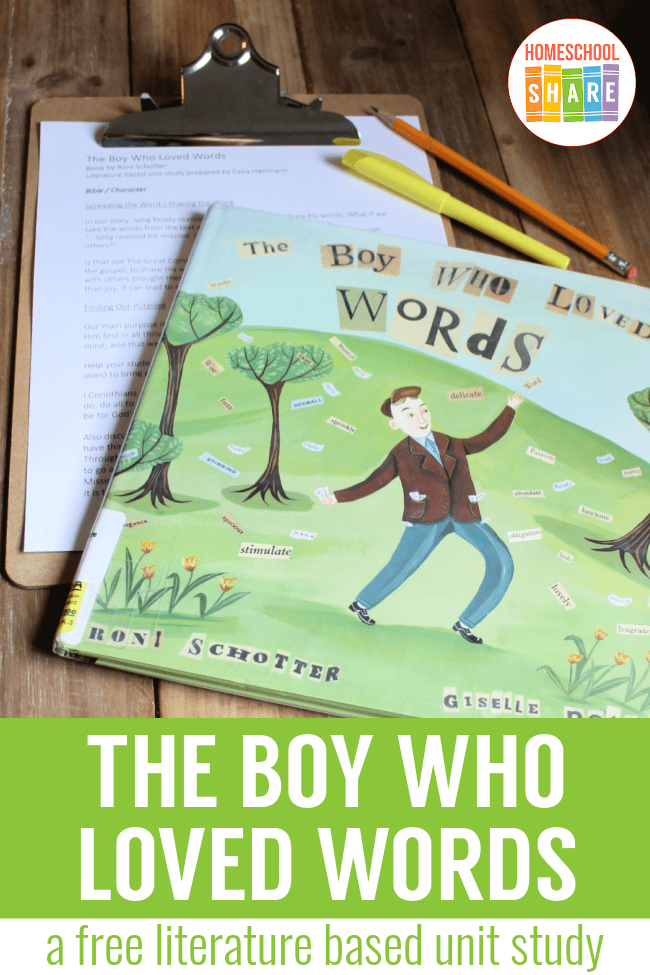
The Boy Who Loved Words, a literature-based unit study for the book by Roni Schotter
The Boy Who Loved Words
 
  Author: Roni Schotter
Illustrator:  Giselle Potter
ISBN: 0375836012
Summary: Some people collect shells or stones; young Selig collects words. Whenever he hears a new one he likes, he jots it down on a slip of paper and stuffs it into a convenient pocket, a sock, a sleeve, or a hat. When you're a kid, such eccentric behavior doesn't go unnoticed, and soon his classmates have given him a new name, "Wordsworth," and a new word to add to his collection, oddball. Ouch! But with the help of a friendly genie, Selig finds his life's purpose.

Unit prepared by Celia Hartmann


Note:  In this story, Selig has a dream and in the dream a genie comes out of a vase and gives advice to Selig.  The genie's advice inspires Selig to go on a mission to find the purpose for his passion of collecting words.


Bible / Character


Spreading the Word / Sharing the Word:  

In our story, Selig finally realizes that his mission is to share his words.  What if we take the words from the text and add two capital letters?   Like this:
"...Selig realized his mission.  It was spreading the Word--sharing His words with others!"

Is that not The Great Commission?  Jesus commands us that our mission is to share the gospel, to share His words with others.  Just as Selig found that sharing words with others brought them joy, so does sharing the gospel with others--and more than joy, it can lead to eternal life for others!


Finding Our Purpose  

Our main purpose in life is to bring glory to God.  Glorifying God means that we put Him first in all things; that we love Him with all our heart, all our soul, and all our mind; and that we give Him the praise and worship that He alone is due.

Help your student to make a list of the specific things he can do (or that he already does) to bring glory to God.  Help him see the 'everyday' things that can be done.  

l Corinthians 10:31 says that "Whether therefore ye eat or drink, or whatsoever ye do, do all to the glory of God."   All of our actions--all that we do--should reflect and be for God's glory.  

Also discuss with him how we can use our talents to glorify God.  Each of us have things we're good at and we can use those abilities for God's work.  Throughout history, God has given certain people special qualities or spiritual gifts to go about His work.  Here are some of them. 
Missionary
It is the special gift given by the Holy Spirit to certain members of
the body of Christ (local church) to minister whatever other
spiritual gifts they have in a second culture or second community.
See 1 Corinthians 9:19-23.

Healing
It is the special gift whereby the Spirit employs certain Christians
to restore health to the sick.
See James 5:13-16, Luke 9:1-2.

Intercession
It is the special gift whereby the Spirit enables certain Christians
to pray for extended periods of time with great positive effect for
the building of the Kingdom.
See 1 Thessalonian 3:10-13, 1 Timothy 2:1-2.

Craftsmanship
It is the special gift whereby the Spirit endows certain Christians
to use hands and minds to build up the Kingdom through artistic,
creative means.
See Exodus 28:3-4.

Hospitality
It is the special gift whereby the Spirit enables certain Christians
to open their homes willingly and offer lodging, food, and fellowship
cheerfully to other people.
See Genesis 18:1-15.

Faith
It is the special gift whereby the Spirit provides Christians with
extraordinary confidence in God's promises, power, and presence so
that they can take heroic stands for their future of God's work in
the church.
See Hebrews 11.

Discernment
It is the special gift whereby the Spirit certain Christians to know
with assurance whether some behavior is of God or of Satan.
See Acts 5:3-6, Acts 16:16-18.

Mercy
It is the special gift whereby the Spirit enables certain Christians
to feel exceptional empathy and compassion for those who are
suffering so that they devote large amounts of time and energy to
alleviate it.
See Luke 10:30-37.

Giving
It is the special gift whereby the Spirit enables certain Christians
to offer their material blessings for the work of the church with
exceptional willingness, cheerfulness and liberality.
See 2 Corinthians 8:1-5.

Administration
It is the special gift whereby the Spirit enables certain Christians
to understand the goals of a given segment of the Church's ministry
and to direct that area effectively, keeping the Church on course.
See Acts 15:12-21.

Leadership
It is the special gift whereby the Spirit enables certain Christians
to motivate, direct and inspire God's people in such a way that they
voluntarily and harmoniously work together to do the Church's work
effectively.
See Hebrews 13:7, Judges 3:10, Exodus 18:13-16.

Helps
It is the spiritual gift whereby the Spirit empowers certain
Christians to willingly bear the burdens of other Christians and help
them in such a way that they can do their tasks more effectively.
See Acts 6:2-4.

Serving
It is the special gift whereby the Spirit empowers certain Christians
to identify unmet needs of people and implement plans to meet those
needs. Serving one another, like witnessing, is a calling of all
Christians, but there are some who have a special desire to find ways
to serve, and get great blessing from it. There seems to be a special
desire to meet physical needs in the people who have this gift.
See Galatians 6:1-2.

Knowledge
It is the special gift whereby the Spirit enables certain Christians
to understand in an exceptional way the great truths of God's Word
and to make them relevant to specific situations in the church.
See Ephesians 3:14-19.

Wisdom
James 3:13-17
See It is the special gift whereby the Spirit endows particular
Christians with an understanding of God's will and work as it relates
to the living of life..

Exhortation
It is the special gift whereby the Spirit enables certain Christians
to stand beside fellow Christians in need and bring comfort, counsel
and encouragement so they feel helped.
See Acts 11:23-24, Acts 14:21-22.

Music
It is the special gift whereby the Spirit enables certain Christians
to praise God through various forms of music and enhance the worship
experience of the local congregation.
See 1 Corinthians 14:26, Mark 14:26.

Teacher
It is the special gift whereby the Spirit enables particular
Christians to communicate the truths of God's Word so that others can
learn.
See Hebrews 5:12-14.

Pastor
It is the special gift whereby the Spirit enables certain Christians
to assume responsibility for the spiritual welfare of a group of
believers.
See 1 Peter 5:1-11.

Evangelist
It is the special gift whereby the Spirit enables particular
Christians to share the Gospel to unbelievers in such a way that the
unbeliever becomes a disciple of the Lord Jesus.
See Acts 8:26-40.

Prophet
It is the special gift whereby the Spirit empowers certain Christians
to interpret and apply God's revelation in a given situation.
See 1 Corinthians 14:1-5, 1 Corinthians 14:30-33, 1 Corinthians 14:37-
40.

Apostle
It is the gift whereby the Spirit appoints certain Christians to
lead, inspire and develop the churches of God by the proclamation and
the teaching of true doctrine.
See Acts 12:1-5, Acts 14:21-23.

Credit for Definitions
Other websites:  Gifted 2 Serve


Bible Verses  

Choose one or two to memorize and/or use as copywork this week.

Jeremiah 15:16
Thy words were found, and I did eat them;
and thy word was unto me the joy
and rejoicing of mine heart:
for I am called by thy name,
O LORD God of hosts.


Proverbs 25:11
A word fitly spoken is like apples of gold in pictures of silver.

Proverbs 15:2
The tongue of the wise useth knowledge aright:
but the mouth of fools poureth out foolishness.

Proverbs 15:23
A man hath joy by the answer of his mouth:
and a word spoken in due season, how good is it!


Social Studies


Geography  - "The Old Country"   When people from various countries (particularly Europe) immigrate to America, they leave behind "their old country."   When they settle, they often refer to "The Old Country" and the way things were there.  They tended to settle near other families from the same country, so they could continue to speak their native language, follow the same customs, and attend a church that was similar to what they left behind.   (If someone in your family immigrated to America, you may wish to discuss what it was like for them, why they left, and how they maintained a connection to the country the left.)

Our story does not tell us from where Selig's family emigrated; however, there are clues to help narrow it down.   See the Art lesson below for how illustrations can give clues to the story's setting.   (You may wish to  create two story disks--one to represent the "Old Country" of your choosing and one to represent New York and place them on world map.  Use a piece of yarn between the two to show the connection.)


Hobbies/Collections:    A hobby is something that someone enjoys doing in their spare time.  For some people their hobby involves collecting things (such rocks, sea shells, coins, stamps, bells, dolls, etc.), while others pursue a sports activity (golf, horseback riding, etc.) or do something artistic (painting, making crafts, play music).  Does your student have a hobby or collect something?  


Games:  Some of the children are shown playing with balls, nets, or bats. Others are sitting and playing marbles.   What games does your student like to play?  If interested, have your student poll several family members to find out what their favorite game is (or was during their childhood).  Graph the results, or just make a list.


Poets:   In our story, a poet was struggling to find the right words.  A poet is someone who is gifted at writing  prose that is beautiful, imaginative, and eloquent.   Poets have been around for a very long time.  They would tell stories and histories for entertainment and as away of preserving the information before written information was readily available.   The oldest surviving poem, the Epic of Gilgamesh, was written in cuneiform (the earliest alphabet) in ancient Sumer (Mesopotamia).

There have been many, many famous poets in history.  Have your student choose one or two and help him learn more about that poet, his works, and why his poetry made him famous. Choose one of his poems for copywork or memorization.   Here are just a few possibilities:
Maya Angelou                       Issa
Basho                                   John Keats
Robert Browning                 Christina Rosetti
E.E. Cummings                    William Shakespeare
Emily Dickinson                   Shel Silverstein
Ralph Waldo Emerson         Walt Whitman
Eugene Field                        William Butler Yeats
Robert Frost


Name Calling / Being Made Fun of:     Selig was called an oddball.   (Again, if you have shared Rocks in His Head, remind your student of how people told the man that he must have rocks in his head--they were making fun of him.)

Discuss how Selig must have felt.  No one likes to be called odd or strange or being made fun of.  Has this ever happened to your student?  Talk about it.   Or perhaps your student has made fun of someone else.  Discuss how the other person must have felt.   Do you think Jesus would want us to call someone names?  What would Jesus want us to do?  1 Thessolonian 5:11 tells us to encourage and build one another up.


Language Arts


Repetition:  Repetition of words creates rhythm in the story along with anticipation.  Ask your student if he can remember the phrases that are repeated throughout the story?   Upon my word!  How lucky we are!  After a couple readings, your child will probably anticipate these phrases and you might pause to allow him to interject these phrases into your reading.


Alliteration:   A few sentences or phrases within the story contain alliteration, the repetition of the first consonant sound.   One example from the story:

Waving her arms in the air, she was a windmill of worry.  

Have your student find others within the story, or make up his own.   For copywork, have him copy the word alliteration along with the definition, then have him copy his favorite from the story (or one of his own).


Legends / Myths:    "And so, by word of mouth, the legend began...."    "Years passed.  Selig was a man now, also a myth."

What are they? How do they get started?

According to Wiki, a "legend is a story, that is probably about someone that did exist but has been twisted to seem more interesting and fascinating. This story is passed down generation to generation."
Some feel that the word legend and myth are interchangeable (i.e., that they mean the same thing), but some think that they are slightly different, that a myth is not based a true story or about a real person.  (Think about Greek and Roman mythology--stories of gods that were made up.)

So do these stories get started?   Just like in our story, it's usually "by word of mouth."  With each telling of the story, new information may be introduced and eventually the story takes on a new flavor.

If your student is particularly interested in legends and myths, he may wish to read about King Arthur, Robin Hood, William Tell, or the Greek and Roman myths.
 

Vocabulary:   There are soooooo many fun and interesting words in this book!  Your child will be overwhelmed if you choose them all to learn.  Instead choose a few that might be fun for him.....or ones that he goes around repeating after the story has been read aloud.  There's a glossary in the back with a list of the words and their definitions.  Also see the art lesson below for an extension of this lesson.


Glossary Skills:  Explain to your student what a glossary is. A glossary is a list at the back of a book that explains the meanings of difficult or unusual words used in the text.  Most picture books do not have a glossary, but because of all the fun (and probably new to the reader) words, the author provided their meanings.  Help your student look up any unfamiliar word from the text in the glossary at the back of the book.


Accent:   Some people talk with an accent.  Has your student ever heard someone talk that sounds different from the way he talks?   People all over have accents:  in the southern United States, New York, Boston.  People who learned English as their second language also have accents.   Accents can help you guess where they come from or their nationality.  

The genie in our story has an accent.  Notice how the sounds that are a /wh/ to us are spoken with a /v/ by him.  Or example:  What = vhat, wish=vish.  

Those of German descent often have an accent that substitutes the /w/ sound with a /v/ sound.

Notice also that the genie's /or/ sound when he said Selig's nickname Wordsworth, instead comes out like an /oy/ ...Voidsvoith.  Same with the word 'words'  ('voids'  ) and the word 'purpose' (poipose).

Looking at picture of the genie, he looks very Jewish, specifically an Orthodox Jew with the long beard, long sidelocks, and black hat and suit.  Many older Jews--particularly Orthodox Jews--speak what is becoming a dying language known as Yiddish, a mix of German and Hebrew.   Yiddish is dying out because fewer and fewer people are speaking it on a regular basis.   (In our art lesson we will/did learn how illustrations often give clues......in this case, the picture of the genie helps to match his speech with his nationality.)

Bunny Trail:  Research Yiddish and learn some Yiddish words!


Literature Tie-in:  find a story of Aladdin to tie in with the genie.


Copywork:  Have your student use his best handwriting with one or more of the following quotes.  (For more copywork ideas, see the Bible section.)
Without words, without writing, and without books there would be no history, there would be no concept of humanity.  --Hermann Hesse

Good words are worth much and cost little.  
--George Herbert
Kind words can be short and easy to speak, but their echoes are truly endless. --Josh Billings


Art

Make a Word Tree:   Find a thing multi-branched twig and secure in a plastic or clay pot that has been filled with floral foam.  (You may wish to use Spanish moss on top of the foam to cover it or just crumple some paper on top.)   Provide your student with strips of paper and have him write down a couple of his favorite words (one per strip of paper).  Next have him find some new words he likes......have him look through a dictionary, magazine, or encyclopedia.

You may wish to start this tree the first day, so he can add to it throughout the time of your sharing.  If you do, here's an extra language arts and handwriting practice lesson:   have him choose two or three words from the tree and have him write one sentence in his best handwriting using those words.

If you use a vocabulary program, also have him include those words on the tree for extra practice of his vocabulary words.


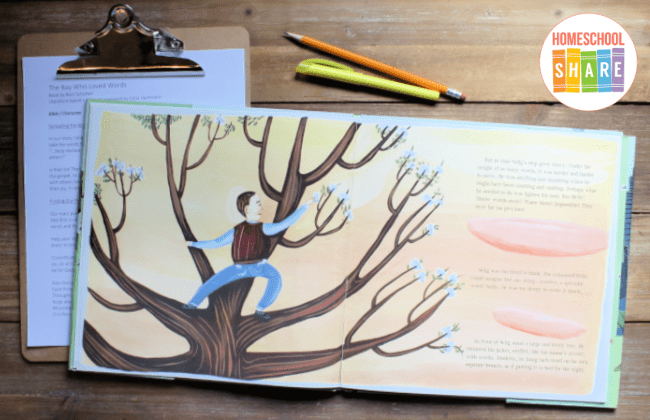
Using the Illustrations to Determine Setting:    Help your student use reasoning skills to determine the setting.  Where might we find people who were originally from "The Old Country?"  When people immigrated to America, they tended to find a place to live close to others from their native country--this was usually in larger cities.  What are some larger American cities?   Is there anything else in the story to help us determine the setting?  How about the pictures of the buildings--do any of them give us a clue?   And what about the picture of the harbor....the Statue of Liberty is there!  Our story takes place in New York City!    


Music

Lute:  In our story, Melody plays a lute.  As you can probably guess from the pictures, the lute is a stringed-instrument.   It has a tear-drop shaped wooden body and a short neck.  The lute was popular from the early renaissance to the late baroque eras, and was somewhat revived with the awakening of interest in historical music around 1900 and throughout the 20th century.   The player of a lute is called a lutenist and a maker of lutes (or any string instrument) is called a luthier.   Source:  Wiki

Bunny Trail:  Both Vivaldi and Bach composed music for the lute.  Perhaps your student would enjoy learning more about one or both of these great composers.


Applied Math

Counting Syllables:   There are so many neat words in the book.  It might fun practice to count the syllables.  Can you student categorize them?  Have him make a list and place the two syllable words in one column, the three syllable in another, and so on.   What word(s) has the most syllables?  (tintinnabulating)


Pie Chart / Percent
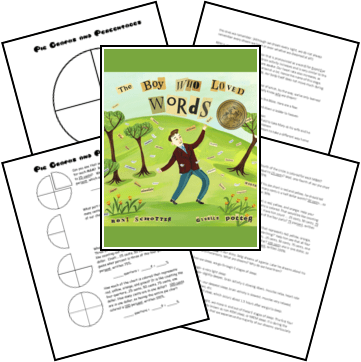
On the page that talks about how Wordsworth became a legend, there is a chalkboard with a circle and a % sign.    Has your student ever seen a pie chart (also called a circle graph)?    

Activity:   Get four M&Ms (one green, one red, one yellow, and one orange).  Explain to him that he will create a pie chart that shows the percentage of color.   Print this prepared worksheet.  

The pie chart on this page represents all of the M&Ms he has out.  Have him color each part of the circle the corresponding color of the M&M.  He has now made his pie chart and next he  will determine percentages (without using any actual calculations!  If you have an older student, you can discuss how percentages are really calculated and create pie charts for him to determine the percentages.)

Give your student four quarters.  Remind him that four quarters is equal to one dollar.  The name "quarter" came from the fact that one quarter is one-fourth of the whole dollar.   So one-fourth of a dollar is a quarter or 25 cents.  

Can your student see that one-fourth of the circle is colored for each M&M?  Remember how one quarter is equal to 25 cents?   Well, one-fourth of our pie chart is 25 percent, which we write as 25%.

If you ask your student what part of his pie chart is red and yellow, he should tell you half.  You can then ask him how many cents is a half dollar worth?  50 cents....so half of our chart is 50 percent, written 50%.

Now, let's look at what part of the chart is red, yellow, and orange.   Help your student to see that three of the four parts is colored.  That would be like counting out three of the four quarters in a dollar.  Have him count ... 25 cents, 50 cents, 75 cents.  Can he guess what percent is three of the four parts?  75 percent, written 75%.

If you ask how much of the chart is colored that represents red, yellow, orange, and green, he will probably tell you "the whole thing!"   Help him see that all four parts would be like counting the four quarters...25 cents, 50 cents, 75 cents, one dollar.  Ask him how many cents are in one dollar?   100 cents are in one dollar, so having the entire pie chart colored is 100 percent, written 100%.


Science

Sleep and Dreams:    In our story, Selig dreams of a genie.  Later he dreams about his mom and macaroons.     What are dreams?  Why do we have them?

When we sleep, we go through 5 stages of sleep.

1st stage--a very light sleep
2nd stage--slightly deeper, brain activity is slowing down, muscles relax, heart rate slows, etc.
3rd and 4th--our deepest sleep, brain activity is slowest, muscles very relaxed, breathing slows, etc.
5th stage--REM sleep, which occurs about 1.5 hours after we go to sleep.

Throughout the night, we move in and out of these 5 stages of sleep.  The first four stages are collectively known as non-REM sleep, or NREM sleep.  It is during the fifth stage, REM sleep, that we experience the majority of our dreams--particularly the ones we remember.  (Although we dream every night, we do not always remember every dream we have or even whether we dreamed at all!)

REM is an acronym (an abbreviation that is pronounced as a word) for Rapid Eye Movement.  During this stage, our brain activity increases and is very similar to the brain activity that occurs when we are awake.     Our heart rate also increases, as does our breathing.  Our eyes move around--a lot, hence the name of this stage.  Despite all the activity inside our body, our body itself does not move much during dream.

For all that we know about dreams (most of which, by the way, we've only learned in the last 50-60 years!), we still don't really know why we dream!

Source of the information:  
Wiki
How Stuff Works


For some interesting dream facts, which you might want to include in your lapbook or notebook, visit How Stuff Works (about 1/2 way down).


You may also wish to explore dreams from the Bible.  Here are a few:


Eye -- Sleep Crumbs:    "Wiping the sleep crumbs from his eyes, Selig scrambled down the tree......."     Do you ever wake up in the mornings and there's gunk in your eyes?  There is no official name for it, but some people call it 'sand' in the eyes or sleepies or goop.

When you are awake, your eyelids blink and work like windshield wipers, wiping away tears, sweat, and oil and other things that get in the eyes.  Tears constantly drip down the eyes from more than a dozen tubes above our eyes.  (Crying produces a flood of these tears.)  Tears keep the eye moist, clean, and clear of anything that might irritate your eyes (this is why more tears form when something is in your eye, they are trying to wash it out!).  

But we have a problem at night...the eyelids are no longer blinking away the tears, sweat, and oil.  So it collects near the caruncle in the commissure.  A commissure is just a word for a place where to things meet or join, in this case, where the upper eyelid meets the bottom eyelid.  The caruncle is the small, reddish bump at the inner corner of your eye.   When you wake in the morning, often the mixture of tears, sweat, and oil have collected in the corner of your eye and that is the sleep crumbs mentioned in  our story.

Complete Anatomy of the Human Eye Diagram


Possible go-along books

For a family read-aloud or an early chapter book for your 3rd-4th grader might be  Donavan's Word Jar by Monalisa DeGross.  Like Selig, Donavan also collects words, but he's reluctant to share them.

Max's Words by Kate Banks

Cookies:  Bite-size Life Lessons by Amy Krouse Rosenthal


Cooking

Many foods are mentioned in this story.  Choose several to share with your student this week.  For example, one day you could serve apples with honey to dip them in, another you could allow your student to drink cream soda, another serve macaroons, etc.  To complete your sharing of the unit, consider serving a supper of brisket with dumplings, plum crumble, strudel, and macaroons.  

Here is a recipe for Easy Macaroons.

Easy Coconut 'Macaroons'

According to legend, macaroons were invited in an Italian monastery over 200 years ago.  Later, during the French Revolution, two nuns (who became known as the "Macaroon Sisters") baked and sold the cookies.  The recipe was given to a Jewish community in France, who then made it a staple of Passover of baking.  It remains a common recipe used during Passover since they are unleavened.  (Source:   Wikipedia.org)  

Macaroons are not an easy cookie to make correctly, so I'll list a simpler, but not quite a true macaroon recipe.

Easy Coconut 'Macaroons'

Ingredients:
2 eggs whites
1 c. white sugar (decrease to .5 cup if desired)
1 c. flaked coconut
2 to 2.5 c. crushed cornflakes cereal (not the sweetened/frosted kind)

Preheat oven to 350 degrees.  Grease the cookie sheets generously.

In a large glass or metal bowl, whip the egg white until stiff, glossy peaks are formed.  Stir in the sugar.  Fold in the coconut and cornflakes.

Drop the mixture by rounded mounds the size of a teaspoon onto the well-greased cookie sheet.

Bake for about 10 to 18 minutes.  They are done when the coconut is golden in color.  Remove from pan immediately using a thin metal spatula.  Makes about 2.5 dozen.