| about us |
what's new
|
unit studies
|
unit study helps |
fiar resources
|
indexes | lapbooking |
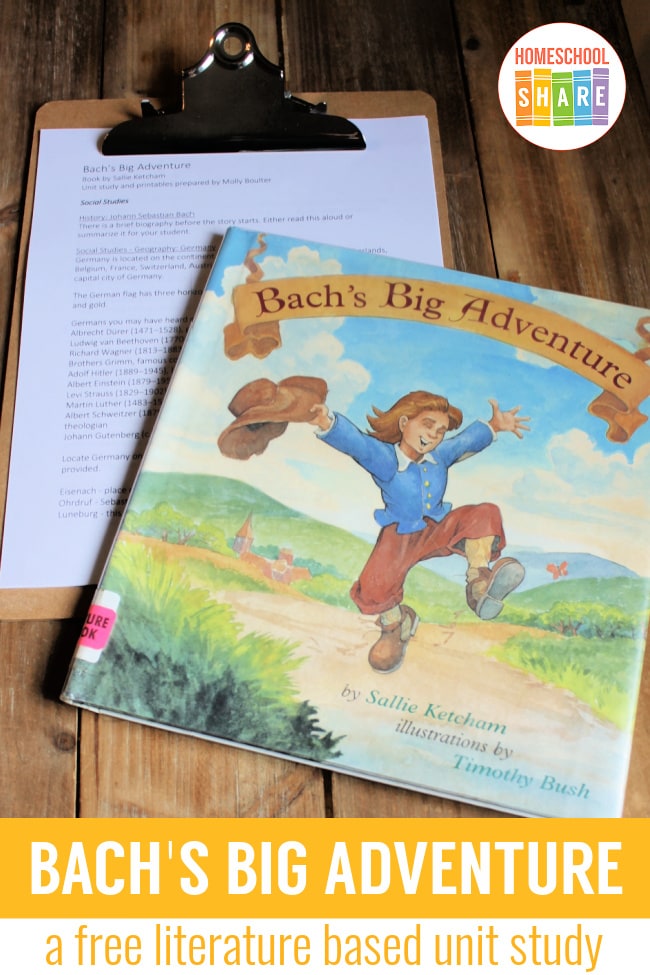
Bach's Big Adventure
|
Author:
Sallie Ketcham Study prepared by Molly Boulter |
Social Studies
History:
Johann Sebastian Bach
There is a brief biography before the story starts. Either read this aloud
or summarize it for your student.
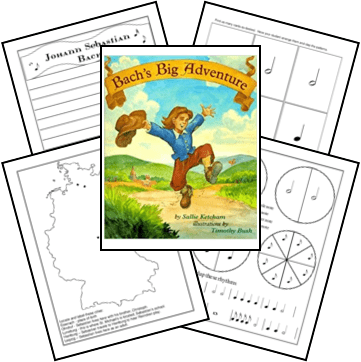
Bach Notebooking Pages
Social Studies - Geography: Germany
Germany is located on the continent of Europe. It is bordered by The
Netherlands, Belgium, France, Switzerland, Austria, Czech Republic and Poland.
Berlin is the capital city of Germany.
The German flag has three horizontal stripes. Black is at the top, followed by red and gold.
Germans you may have heard of:
Albrecht Dürer (1471–1528), painter
Ludwig van Beethoven (1770–1827), composer
Richard Wagner (1813–1883), composer
Brothers Grimm, famous collectors of fairy tales
Adolf Hitler (1889–1945), leader of the Nazi regime
Albert Einstein (1879–1955), physicist
Levi Strauss (1829–1902), jeans
Martin Luther (1483–1546), of the Protestant Reformation
Albert Schweitzer (1875–1965), musician, physician, pastor, philosopher and
theologian
Johann Gutenberg (c. 1390s – 1468), printer
Locate Germany on a map.
Locate the
cities in the story using this printable
map.
Eisenach - place of birth
Ohrdruf - Sebastian lives here with his brother, Christoph.
Luneburg - this is where St. Michael’s is located, Sebastian’s school.
Hamburg
– Sebastian travels to Hamburg to hear Reincken play.
Leipzig – Sebastian lives here as an adult.
Use a green pencil to connect the cities in the order listed above.
German Foods:
A typical breakfast in Germany might have eggs, bread and cheese. Traditionall
the main meal of the day would be lunch. Germans typically eat a lot of meat
with pork being the most common. Dinner is would have been a lighter meal,
similar to breakfast.
For a typical dessert, you can try the following recipe:
Streuselkuchen (crumb cake)
Topping
¼ cup sugar
¼ cup brown sugar
2 teaspoons cinnamon
1 cup flour
½ cup butter
Cake
2 ¼ cup flour
¼ cup sugar
¼ teaspoon salt
1 package dry yeast
¾ cup milk
½ cup butter
1 egg
fruit if desired
To make topping:
Mix sugars, cinnamon and flour. Cut in butter until mixture is crumbly.
To make cake:
Mix 1 cup flour with sugar, salt and yeast in a large bowl. Place milk and
butter in a saucepan and heat until very warm (120°F). Gradually add to dry
ingredients; beat 2 minutes. Beat in egg and 1 cup flour. Beat on high speed for
2 minutes. Stir in enough flour to make a soft but stiff batter. Spread batter
into a well-greased 9-inch square cake pan. Sprinkle with topping. Let rise in a
warm place until double in bulk, about 1 ½ hours. Bake at 350°F about 45 minutes
or until done. If you like, add your favorite fruits beneath the topping before
baking to make a fruit cake.
For this and other recipes visit this site.
Character: Humility
Define humility. (A modest opinion of one's own importance) Was Bach
humble? Throughout the story Sebastian yells, "I am Bach!" Does he ever
learn humility?
It is true that Bach was very talented. God gives gifts and talents to each of us. It is important, however, to remember that these gifts come from God to be used for His glory, not our own. When we have a spirit of pride, we are trying to take the glory that belongs to God for ourselves.
I have talked to my kids about two different kinds of pride. Moms and dads are going to be proud of their children, and that is okay. Let's just remember to thank God for our special gifts and not to take credit for the gifts we have but to use them for His glory.
Language Arts
Compound Words
Compound words are two words put together to make one word. Can your
student think of examples on his own? Take a look at these compound words found
in the story–
Choirmaster
Birdsong
Birdcalls
Secondhand
Farmhouse
Hillsides
Punctuation:
Hyphens
When two adjectives are put together to make one word they are hyphenated..
Look on the page that begins with, “And walk he did.” There are examples of
hyphenated words on this two page spread. Have your younger student point
out the hyphens.
salt-traders’
wind-whipped
half-timbered
Fine Art
Music Theory
You can discuss basic notes and rhythm in the 4/4 scale.
A whole note holds for four beats.
A half note holds for two beats.
A quarter note holds for one beat.
An eighth note holds for half a beat.
There are printable note cards for your student to use and rearrange in order to make up different beats. Practice counting and clapping different beat patterns.
Classical Music – Baroque
Different
periods of time bring about different styles of music. On the classical
music timeline, the Baroque Period (1600-1750) comes after the Renaissance
period and before the Classical period. The Baroque era gave birth
to the beginning of the orchestra. Composers would place musicians
all over the church-- in the balconies, by the altar, etc. The audience
was surrounded with the sounds of the music creating an amazing experience!
Baroque music is characterized as tuneful and organized with decorated and
elaborate melodies. Movements within the music contain conflict,
contrast, and drama (you may hear a fast movement, then a slow movement, then
another fast movement). These same elements were also prevalent in the
artwork and architecture of the time.
Bach is
known for bringing the Baroque period to its height. Other composers in this style were Monteverde, Vivaldi
and Handel.
Math
Fractions
Does your student notice anything about these words whole / half / and
quarter notes? They sound a lot like fractions. Each bar in a sheet of music
is a whole and the notes tell you how many sections in which it is divided.
You may want to take a look at the Rhythm/Fraction page for an illustration.
Practice counting and clapping different beat patterns.
Measurement- Speed
Sebastian
walked 30 miles from Luneburg to Hamburg. If he walked at the rate of 5 miles
an hour, how long would it take? 3 miles an hour? 2 miles an hour?
Science
Anatomy- Ears
Music is
enjoyable because we can hear it! Sound is collected by your outer ear (pinna
or auricle). Once the sounds is collected it moves into the ear canal and from
there to the ear drum. The ear drum vibrates and cause three tiny bones to also
vibrate (hammer, anvil and stirrup). From there, the vibration is transferred
to the cochlea. The cochlea has tiny hairs which signal the nerves to send
sound messages to the brain.
Ear Print-out
Try this: cup your hands around your ear to collect even more sound. Does it work?
Try this: wrap plastic wrap tighly over a bowl. Sprinkle some dry rice on top. Now, hit a metal pan with a spoon right next to the bowl. What happens to the rice? This is similar to the way your ear drum works.
Just for Fun
Radio show with excerpts of music
Real
Heroes for Today's Kids: Bach
Enchanted Learning
Bach Biography
Enchanted Learning Music Theory Pages
Additional
Resources:
Sebastian Bach:
The Boy from Thuringia by Opal Wheeler
Baby Needs
Baroque (CD)