Affiliate Disclaimer
We sometimes use affiliate links in our content. This won’t cost you anything, but it helps us to keep the site running. Thanks for your support.
Yee-haw! Grab your cowgirls and cowboys and get ready to have a rip-roarin’ week of learning with our Armadillo Rodeo activities and lessons.
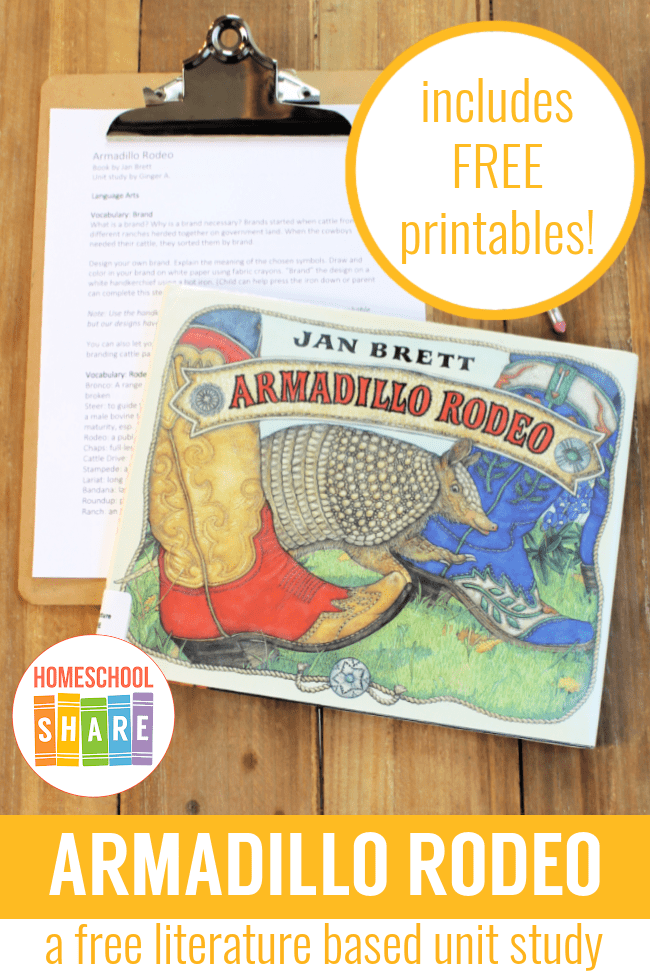
Thanks to Ginger A. for preparing this Armadillo Rodeo unit study.
Armadillo Rodeo Activities and Lessons
Armadillo Rodeo Language Arts and Literacy Activities
Vocabulary: Brand
What is a brand? Why is a brand necessary? Brands started when cattle from different ranches herded together on government land. When the cowboys needed their cattle, they sorted them by brand.
Design your own brand. Explain the meaning of the chosen symbols. Draw and color in your brand on white paper using fabric crayons. “Brand” the design on a white handkerchief using a hot iron. (Child can help press the iron down or parent can complete this step.)
Note: Use the handkerchief as a decoration. Fabric crayons are labeled washable but our designs have always faded.
You can also let your student brand the cattle by using a rubber stamp and the branding cattle page.
Vocabulary: Rodeo Vocabulary
- Bronco: A range pony or mustang of the western U.S., especially one that is not broken
- Steer: a male cow esp. one raised for beef
- Rodeo: a public exhibition of cowboy skills, as bronco riding and calf roping.
- Chaps: full-length leather leggings worn over pants to protect legs.
- Cattle Drive: the act of moving a herd of cattle from one place to another
- Stampede: a wild rush or flight of frightened animals
- Lariat: long rope with a loop at one end used to capture cows and horses
- Bandana: large and brightly colored handkerchief; often used as a neckerchief
- Roundup: process of collecting cattle and leading them to the ranch.
- Ranch: an establishment maintained for raising livestock.
Vocabulary printable is included in the download for this Armadillo Rodeo unit study.
Descriptive Language
Print two pictures of the cowboy boot (or draw two boots).
Harmony Jean has a new pair of custom-made cowboy boots. What does custom-made mean? Read aloud the description of Harmony Jean’s boots. (The page begins “Curious as always, Bo…)
Have your student describe a custom-made design for the first cowboy boot picture. The parent should complete the picture according to the child’s description. Show the completed picture to your child. Does it look the way he had planned? If not, discuss why.
Complete the above mentioned activity but parent and child should trade places. Did the child listen and follow your design? Don’t look at the art skill but rather the attempt to create the design to your specifications.
Armadillo Rodeo Math Activities
Pairs
Harmony Jean has a new pair of cowboy boots. How many is a pair? Why would two items be considered a pair? Gather several pairs of shoes from each family member. The child should arrange the pairs of shoes into a line. Ask the following questions. The parent can make up other appropriate questions.
- How many pairs of shoes do you see?
- How many shoes all together?
- How many pairs of sneakers are in the line?
- How many pairs of boots?
- How many pairs of shoes are left after mom puts her shoes in the closet?
- Are there more leather or canvas shoes?
- How many ways can these shoes be categorized?
Counting by 2s
Learn this fun rhyme together.
Counting Tumbleweeds
Ten little tumbleweeds by the corral gate,
The wind whooshed two away, and then there were eight.
Eight little tumbleweeds said, “Oh! Fiddlesticks!”
“We may as well dance with the wind.” Then there were six.
Six little tumbleweeds went out to explore;
Along came a whirlwind and then there were four.
Four little tumbleweeds admiring the view; Then came a gentle breeze; so there were two.
Two little tumbleweeds: round and round they spun,
Until they were out of sight; then there were none!
–author unknown
Print a copy of the poem for the child. Read it aloud. Underline the number words. Find the counting pattern used. Try to count forward and backwards by twos.
Armadillo Rodeo Cooking Activities
Tumbleweeds
- 1 can [12oz.] salted peanuts
- 1 can [7 oz.] potato sticks
- 3 cups butterscotch chips
- 3 T. peanut butter
Combine peanuts and potato sticks in a bowl: set aside. In a microwave, heat butterscotch chips and peanut butter at 70% power for 1-2 minutes or until melted, stirring every 30 seconds. Add to peanut mixture; stir to coat evenly. Drop by rounded tablespoons onto waxed paper lined baking sheets. Refrigerate until set, about 5 minutes. Store in an airtight container. Yields about 4 ½ dozen.
Notice the use of standard and nonstandard measurements. Why? Check into this the next time you’re in the grocery store. Show the child how to find the weight on the cans.
Cowboy Chili con Carne
- 2 T. bacon drippings or vegetable oil
- 1 clove garlic, minced
- 1 small onion, chopped
- 1 small bell pepper, chopped
- 1 [16oz.] can tomatoes, including liquid
- 1 [16oz] can chili beans, including liquid
- 1 [15 ¼ oz.] can red kidney beans, including liquid
- 2 t. salt
- 1 t. granulated sugar
- 2 T. vinegar
- ¼ t. ground black pepper
- 3 T. chili powder
- 1 pound lean ground beef
- ½ c. onion chopped
- ½ c. Cheddar cheese, grated
Heat 1 T. of the bacon drippings in a large frying pan and sauté garlic until golden brown. Add chopped onion and green pepper. Cover pan and cook over low heat until onion is translucent.
Meanwhile, mash canned tomatoes in own liquid in a four-quart saucepan or Dutch oven, then add chili beans and kidney beans, including the liquid. Add salt, vinegar, pepper, chili powder, Tabasco sauce to beans and tomatoes and bring to simmer. Add sautéed garlic, onion and green pepper. Reheat frying pan and sauté beef in remaining bacon drippings, stirring with a fork to crumble, until cooked.
Drain off fat and add beef to bean mixture in saucepan. Simmer, uncovered, for about 45 minutes, stirring occasionally.
Serve in bowls topped with chopped onion and cheddar cheese. Accompany chili with saltine crackers or hot buttered tortillas.
Armadillo Rodeo Social Studies Activities
Geography: Texas
Locate Texas on a state map. Find a book or website about Texas and read through it together.
The Nine Banded Armadillo is the state animal of Texas. Draw an armadillo following the directions at Jan Brett’s website. (Learn to Draw an Armadillo)
Alternate Idea:
Draw the armadillo on card stock and cut it out. Cut nine strips and lots of circles from a newspaper [black and white pages only] and glue into place. Add a black button or wiggle eye.
Armadillo Rodeo Science Activities
Bluebonnets
Buy a package of Bluebonnets. Observe then describe the picture on the seed package. Plant three seeds. Watch the seeds. Record your observations on the chart (i.e. sprouted today!). Be sure to measure the plants when they start growing and to record that data as well. You may want to place the three plants in three different areas of your home. Do you notice any differences?
Extra Reading: The Legend of the Bluebonnet by Tomie dePaola
Armadillos
Learn about armadillos! The armadillo is unable to swim. To cross a small body of water it walks across the bottom. To cross a large body of water it fills its body with air and floats to the other side.
Activity: floating and sinking
- Gather a variety of objects for the child to test.
- Label a plastic box “Yes” and another box “No”
- Fill a large plastic storage box with water.
- The child will test each object by placing it in the water.
- Objects that float are placed in the “Yes” box.
- Objects that sink are placed in the “No” box.
- Compare/contrast the objects in the two boxes.
- Experiment and find out if an object that floats can hold up an object that sinks.
Activity: Can an inflated Ziploc bag float?
Seal a Ziploc bag forcing all the air out of it. “Air up” another Ziploc bag and seal it. Place both bags in the water. Observe the bags. Gently press the flat baggie down. What happens? Gently press the inflated baggie down. What happens? How is this similar to the armadillo? How do arm floats and swim toys float? Now pop the baggie. What happens? Why are inflated items not safe as a life-saving device?
Armadillo Rodeo Life Skills
Sewing
Here are two simple sewing projects. The pillow is not difficult but it is time-consuming. Teach your child how to stitch a running stitch before beginning. It isn’t necessary to really practice as that is what this project is for.
Bandanna Pillow
Purchase two bandanna handkerchiefs. Help the child pin the edges together (right sides facing). Leave an opening for turning the pillow. Stitch the pillow together, turn and stuff. Sew the opening closed.
Bandanna Apron
Measure the child from hip to hip in the back and add enough to this to tie a bow. Now measure around his neck. (area where you would tie an apron) Add the measurements together and purchase that amount of grosgrain ribbon. You will also need to purchase a bandanna. Here are the steps to follow:
1. Lay the bandanna “diamond shape” in front of the child.
2. Fold the top point down to make a tunnel wide enough for the neck ribbon to pass through. Sew the point in place. Thread the length of neck ribbon through. Secure the ribbon in place with a stitch or button.
3. Divide the left over ribbon in half. Pin one length to the point on the left. Sew into place.
4. Pin the other length to the point on the right and sew into place.
5. Dip ribbon ends into no-fray or a similar product.
6. Now you are ready to whip up a batch of tumbleweeds.
Armadillo Rodeo Art Activity
Western Sunset
Observe a sunset noting the colors that streak the sky. Choose appropriate watercolor paints. Fill an entire sheet of white paper with the sunset colors, making broad strokes from left to right. Allow the paint to dry. Draw a mountain, tree and cactus on black paper using a white crayon. Cut out the silhouettes (explain this term) and glue to the painting.
How to Get Started with the Armadillo Rodeo Activities and Lessons
Follow these simple instructions to get started with the Armadillo Rodeo activities, lessons, and printables.
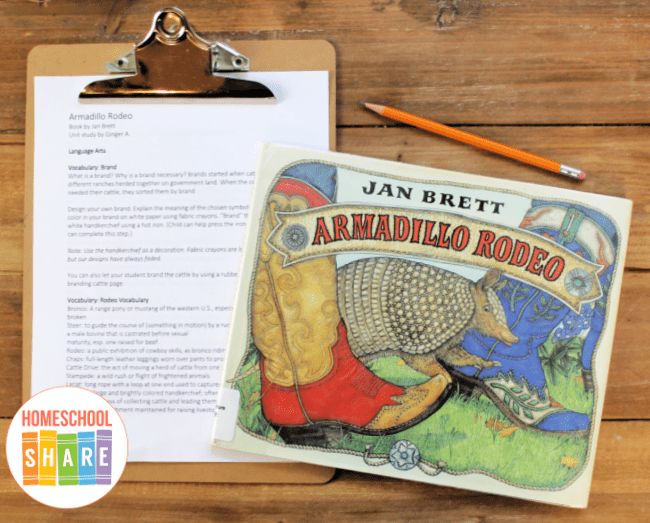
- Buy a copy of the book, Armadillo Rodeo, or grab one from your local library.
- Print the Armadillo Rodeo unit study.
- Choose the lessons you want to use with your student (a highlighter works great for this).
- Enjoy a week of fun-filled learning with your student.
Download Your Armadillo Rodeo Unit Study and Printables
Simply click on the image below to grab your free Armadillo Rodeo lessons.
Resources to Compliment Armadillo Rodeo
These cowboy themed resources may compliment your Armadillo Rodeo unit study, or you may find them useful for an older student who wants to join in the fun.
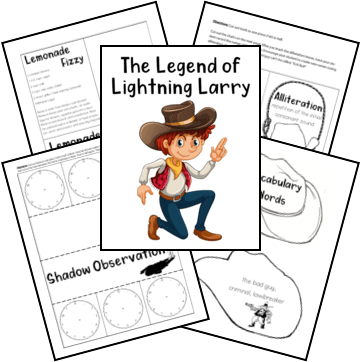
Unit Study and Lapbook