Affiliate Disclaimer
We sometimes use affiliate links in our content. This won’t cost you anything, but it helps us to keep the site running. Thanks for your support.
Based on a true story of a wintry night in 1917, the book tells about a woman and her two daughters who are involved in an accident while riding in a giant horse-drawn sleigh in Alaska.
Thanks to Celia Hartmann for writing the lessons for this Baby in a Basket unit study.
Baby in a Basket Unit Study Lessons
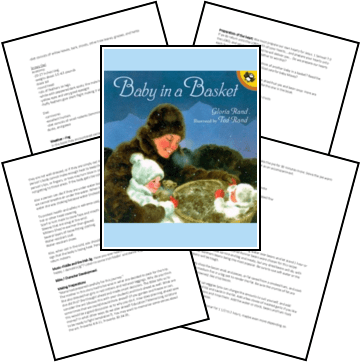
This unit study includes lessons based on the book Baby in a Basket by Gloria Rand.
Here are some sample lessons from the Baby in a Basket Unit Study:
Geography: Alaska
Alaska, which once belonged to Russia, is America’s largest state. America bought it in 1867 at 2 cents an acre.
Alaska is a peninsula Northwest of the main land of the United States. To the north of Alaska is the Arctic Ocean. To the South is the Gulf of Alaska and Pacific Ocean. To the west is the Bering Sea.
Alaska’s land borders Canada to the east and south. You may also want to point out the Arctic Circle, Beaufort Sea, and the Chukchi Sea.
The highest point in the US is located in Alaska, Mount McKinley. The capital of Alaska is Juneau. Near the ocean, the climate is milder, but inland, the summers are short and winters are very long and cold. The coldest temperature ever recorded in Alaska was –80 degrees F on January 23, 1971, at Prospect Creek. Alaska is known as the “Land of the Midnight Sun.”
In the North when the sun rises on May 10th, it doesn’t set for nearly 3 months. When it sets on November 18th, it does not rise again for about two months. In Anchorage the snow starts to fall in early October and it stays till April.
If you want continue studying Alaska, try searching for info on Gold in Alaska, the Iditarod, Balto, life cycle of the salmon, auroras, glaciers, etc.
Language Arts: Non-fiction vs. Fiction
Non-fiction is a work that draws its information from history or fact, rather than the imagination. Make a chart with FICTION and NON-FICTION at the top. Discuss some stories you have studied recently. Which ones were fiction? How do you know? Which ones were non-fiction? Why?
Math and Language Arts: Fifteen Days
The journey from Alaska to Washington State was fifteen days (see author’s note). Make a list with your student of everything he would need to pack if he were going on a ten-day journey in the cold winter (but had limited space). After you make the list together, you may want to write some story problems based on your items.
For example:
If you packed 10 bags of sunflower seeds and ate two bags each day, what day would you run out?
If you started your journey on Monday, what day would you make it to Washington? Think of other questions to use as story problems.
You can grab a copy of the entire Baby in a Basket Unit Study in an easy-to-print file at the end of this post.
How to Get Started with Your Baby in a Basket Unit Study
Follow these simple instructions to get started with the Baby in a Basket Unit Study:
- Buy a copy of the book, Baby in a Basket, or borrow one from your local library. This book is currently out of print, but you may be able to obtain one to borrow through your local library’s interlibrary loan program.
- Print the Baby in a Basket unit study.
- Choose the lessons you want to use with your student (a highlighter works great for this).
- Enjoy a week of literature based learning.
Get Your Baby in a Basket Unit Study
Simply click on the image below to access your free Baby in a Basket Unit Study.
More Winter Related Resources