| about us |
what's new
|
unit studies
|
unit study helps |
fiar resources
|
indexes | lapbooking |
The Quiltmaker's Gift
Author:
Jeff Brumbeau
Illustrator:
Gail De Marcken
Summary: A generous quiltmaker finally agrees to make a quilt for a greedy
king but only under certain conditions (which will change his heart).
ISBN: 0439309107
Literature Based Unit Study
written by Ami Brainerd (Art Lessons by
Brandy Shutt)
Social Studies: Geography--The Seven Continents
A two-page picture spread (about ¾ way through the book)
shows the king traveling the world as he gives he gifts away. This is a great
opportunity for you to introduce your student to the seven continents. Be sure
to name the continents aloud as you move your story disk from continent to
continent each day. One way you can do this is by asking your student to
remember (or imagine) items the king gave away and choose a destination for the
king to deposit that item. For example, your student may remember the blue
waltzing cats. You can say, “the king is going to leave the blue waltzing cats
in Asia. Do you remember where Asia is?” Have him (or help him) move the story
disk there and then continue with the game. What else did the king give away?
“That’s right, he gave away a mirror. Move to Australia and have him drop it
off.” Keep going until you have traveled around the world.
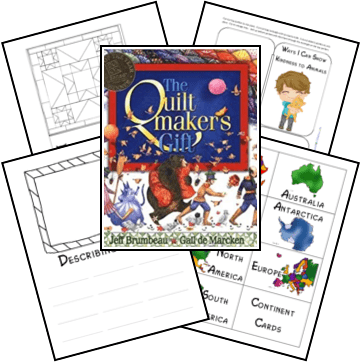
Seven Continents Layered Book for
your Lapbook
Seven
Continents Activity Book
World Outline Map (Label the Continents)
Social Studies: Kindness to Animals
Ask your student if he remembers what parts of the story the quiltmaker is kind to animals. He may mention that she sews a pillow for the bear and little purple jackets for the birds. Discuss with your child ways to be kind to animals and how God wants us to treat animals (Proverbs 12:10). One practical idea for our Indiana winter is to make a Pinecone Bird Feeder (see instructions below). You could also make a bird house or a different type of bird feeder.
Pinecone Bird Feeder:
What you need:
What you do:
Roll the pinecones in lard, then in birdseed or popcorn. Attach a string long enough so that the pinecone can hang from a tree branch. Find a tree that you can see easily; hang your feeder there and watch the birds come!
Using a blend instead of straight peanut butter or lard-- It is recommended by the forestry service to mix cornmeal & lard (or melted suet or shortening) in with the peanut butter before applying to the pinecone because straight peanut butter can be strangling to smaller birds - they cannot get it off their beaks and it becomes like glue.
Add just enough of each to stiffen the consistency; apply to the pinecone; roll in birdseed
Language: Adjectives—Words that describe
Find the page with all the king’s things. Read it again
with your child... “Things that shimmered and glittered and glowed…” Can you
describe the things in the room with your child? Try to fill in the blank:
Things that _________ or fill in this blank ________ things. You
can look at the lizard and say, “let’s describe the lizard – slimy things
or green things.” Now, try it for any of the other objects. Ask your
child, “What do you see?” I see sparkling things, red things,
yellow things, silver things, frosted things, breakable
things, sharp things. You get the idea. You don’t have to use the word
adjectives, but at least you know you are paving the way. If your child
can’t think of any describing words, you can play a game with it. “I see
flying things, can you find them?” As you play this game, your child will
learn new describing words.
Go-along book for learning about adjectives: Many Luscious Lollipops by
Ruth Heller
Language: Vocabulary/Drama
greedy To be greedy is to want more than one needs or deserves. The greedy king insisted on two birthdays every year and had much more than he needed (refer back to the king’s things picture).
stashed When something is stashed, it is hidden or stored away (sometimes in a
secret place). The king’s things had to be stashed because he had more than he could ever use.
seize When someone seizes something, they forcefully take or grab it. The king
ordered the soldiers to seize the star quilt.
wailed A wail is a long, loud, high-pitched cry indicating remorse, grief, or protest. The king wailed when he realized what he had done to the quiltmaker (because he thought the bear had most likely eaten her—you may or may not want to share this with your child. It reminds me of King Darius when he threw Daniel into a den of lions; I bet he wailed as well.)
After you introduce the vocabulary words to your student,
have fun acting them out. Show them how to stash, seize, and wail!
Just for Fun
Finding the King's Things!
idea contributed by Oney Jones
Math: Geometry—Shapes and Quilt Patterns
Quilts use a variety of shapes to come together for a pattern. Choose one of the quilt templates provided and make a copy on cardstock. Cut it up and see if your child can replicate it. If you make four copies, your child will have enough shapes to make four quilt squares which will make a mini-quilt (you can let them glue it down to another piece of cardstock if you like).
Quilt patterns also lead to a discussion about triangles. What actually looks like a square in a quilt pattern may be two triangles of the same material. What can your child make from two triangles? (a square) What shape can your child make from three triangles? (another triangle) What shape can your child make from four triangles? (a rectangle)
Math: Graphing (continued from the previous lesson)
Ask your student to record how many shapes of each color they used in their
paper patterns and plot these results by making tally marks on a graph (I have
provided some, but you may want to make your own to suit your needs; I did not
write red triangle instead I only wrote triangle so each student
can use the colors they want. Fill in the color names or color with a crayon as
appropriate).
Prepared Graph for Snail's Trail and
Friendship Star Patterns
Prepared Graph for Spool Pattern (younger
student)
Science: Biology—Bears
In the story, the king leaves the
Quiltmaker there to be eaten by the bear. Instead of eating the Quiltmaker,
the bear eats a breakfast of honey, blueberries, and tea. Ask your student
which items bears really eat. If the bear was hungry enough (and if
the Quiltmaker hadn't been so kind), would the bear have eaten her?
(probably!)
Bears are omnivores—they eat both meat and
plants. Ask your student if he is an omnivore?
Bears eat many things including blueberries and honey (although I don’t think
they drink tea!); some of their most popular menu items include fish, berries,
roots, leaves, nuts, deer, and insects. Bears also like honey, but what they
really like are the bees and bee larvae (young worms) inside the beehive. If
you feel adventurous make a bear-friendly lunch! However, you may want to skip
the insects and bee larvae!).
Science: Considering God’s Colorful
Creation
Re-read the third paragraph on the
first page of the story (“The blues seemed to come from the deepest part of the
ocean, the whites from the northernmost snows…”). God has certainly used many
wonderful colors in his awesome creation. Using your child’s crayon box, pull
out a color and ask her to name something God made that is the same color. For
a variation of this, you can make a list or a chart. For yet another
variation, you could cut-up a magazine looking for things God made. You could
glue the red creations to a red piece of construction paper, the blue creations
to a blue piece…etc.
Character Qualities
Kindness—The Quiltmaker is kind to the bear (who is angry). Her kindness returns kindness as he then sets her free. Proverbs 15:1.
Contentment—Is there such a thing as contentment in our American culture? We are bombarded with the idea that we need more—a nicer car, a bigger house, new clothes, the latest toys, a different mate, a better job, etc. I hope my husband and I fight this type of thinking in our own lives and can pass a different philosophy to our children. The dictionary definition of content is so simple and yet so convicting at the same time-- Desiring no more than what one has; satisfied. This year, instead of making a Christmas list, you may want to consider making a blessing list with your children. I don’t really know how to teach contentment, but I do know that we can model it. We can talk to them about God’s provision (Philippians 4:19, Matthew 6:28-34). We can and should teach them the difference between a want and a need and exhort them to “be happy with what you have.”
Other spiritual lessons you may want to pursue—greed, giving (giving all—Christ; Christ also asked the rich young man to give all he had), and sharing with those who need.
Additional
Resources
Suggested Websites:
Quilt
patterns for Spool, Snail’s Trail, and Friendship
Star (for the Math section)
activities, websites, lesson plans, information, more!
information about the
illustrator
all about black bears
Blueberry waffles with a blueberry sauce that includes honey! YUM!
Black Bear Maze
Black Bear Maze II
Video Suggestion: Madame Blueberry (Veggie Tale) (tie in: contentment)
Supplemental Book Titles
Just for Fun!
Tea-Time!
It seems the Quiltmaker has her
teapot attached to her at all times. The story shows her drinking tea and
mentions blackberry tea. Purchase some blackberry tea the next time you are at
the grocery store and share it with your child. You may even want to read the
story again as you drink! For a special touch, sweeten it with honey and serve
with blueberry scone recipe.
Blueberry Scones
2 cups all-purpose flour
1/4 cup packed brown sugar
1 tablespoon baking powder
1/4 teaspoon salt
1/4 cup butter, chilled
1 cup fresh blueberries
3/4 cup half-and-half cream
1 egg
Preheat oven to 375 degrees F (190 degrees C).
Cut butter into mixture of flour, sugar, baking powder, and salt. Add blueberries and toss to mix. In separate bowl beat together cream and egg, and slowly pour into dry ingredients, stirring with rubber scraper until dough forms. Knead just until it comes together, 3 or 4 times. Don't over-handle. Divide dough in half. On lightly floured board, shape each half into a 6-inch round. Cut into 6 wedges. Bake on un-greased sheet about 20 minutes at 375 degrees F (190 degrees C). Serve warm!!
Rabbit
Trails
Social Studies: Human Relationships—The Tradition of
Gift Giving
You may want to research this and explain to your child why
we give gifts at birthdays, Christmas, and just for fun. (You could also assign
the research project to an older child in your family to get them in on this
learning experience.) You may also want to make an effort to grab a name off of
an angel tree this year at Christmas and let your child go and help choose the
gift. You may also want to challenge your child to go and find ten things to
give away (to the Salvation Army or another local charity).
Social Studies/Science: Bears of the World
Your older student may want to research different species of bears (panda
bear, black bear, polar bear, etc.) from around the world and label the outline
map (in geography section) as to which bears live on each continent.