| about us |
what's new
|
unit studies
|
unit study helps |
hss resources
|
fiar resources | indexes | lapbooking |
This entire book could be a present day parable, I believe. Here are the parallels I found…
Compare and Contrast
Urban (City) Life to Rural (Small Town) Life
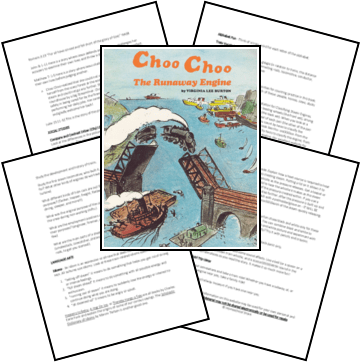
Look at the differences in the pictures. The small town is mostly houses and a
few small businesses. The city is made up of big buildings (businesses and
apartment buildings) and skyscrapers. What is your city/town like? If you live
in the city, have you ever visited a small town, or vice versa? How do we get
between the two? How are businesses connected between the two? Choo Choo played
a big role in mail/freight delivery and personal transportation. When this book
was written, many people did not own their own cars, so they were dependent upon
trains for transportation. Going to the city was a major outing for a family.
Personal Responsibility
– We need to take care of what we have. Jim, the engineer, took good care of
Choo Choo. He shined and polished her and oiled her parts to keep her running
smoothly. We need to take care of things that belong to us…not throwing books,
playing carefully with our toys, not leaving things outside to get ruined, not
stepping on toys, putting things where they belong so we don’t lose pieces, etc.
Obviously this book could lend itself to an extensive study on trains…
Study the development and history of trains.
Study the first steam locomotive, who built it, when was it, what was it used for? What other kinds of engines do we have now? (diesel, steam, electric, turbine)
What different kinds of train cars are out there and what are their various purposes? (Tanker, hopper, freight, flatbed, coal, boxcar, logging, passenger, dining, sleeper, and more!!)
What was the original purpose of the caboose and is it still used? (To house the crew during non-working shifts.)
What are the employment positions available with the railroad and what are their purposes? (engineer, fireman, conductor, switchman, driver, to name a few)
What are the main parts of a steam engine and what are their purposes? (smokestack, cowcatcher, pistons, wheels, boiler, cab, couple, connecting rods, to get you started!)
“letting off steam” It means to do something that helps you get rid of strong or intense feelings.
“full steam ahead” It means to do something with all possible energy and enthusiasm.
“running out of steam” It means to suddenly lose the energy or interest to continue doing what you are doing.
“all steamed up” It means to be angry or upset.
Alphabet fun - Think of a train word for each letter of the alphabet.
Train Vocabulary:
Couple, cowcatcher, boiler, steam, gauge (in relation to trains, the distance between the rails), tender, pilot, connecting rods, locomotive, conductor, engineer, fireman, rail, tracks, caboose
Applied Math
Counting - There are numerous opportunities for counting practice in this book. One page in particular has several of each of these: people, horses, cows, ducks and chicks, birds.
Counting by twos – Based on the Whyte Notation for Classifying Steam Engines, steam engines have three kinds of wheels – leading wheels (the front set), driving wheels (the middle set), and trailing wheels (the back set). When you look at a train from the side, you can only see one wheel of each pair (the other of the pair is on the other side which you cannot see). You count by twos to classify the engine. Here is a small picture. A train’s might look like this- ooOOOoo -from the side at which you are looking. You would count by twos to classify the engine, from the front to the back. This one would be a 4-6-4 engine. (An excellent website for this is http://en.wikipedia.org/wiki/Whyte_notation .)
Shapes – Cut shapes from construction paper - squares, rectangles (cars & windows), triangles (smokestack & cowcatcher), cylinders (tanker cars), and circles (wheels). Glue them onto another paper and make a train.
Parallel lines –
Discuss and model the definition of parallel (lines extending in the same
direction, never getting closer together or further apart). Train tracks consist
of two parallel lines. What are some other examples of parallel lines? Can your
student draw parallel lines?
Perpendicular –
Discuss and model the definition of perpendicular (a line meeting another at
right angles). Explain that train tracks consist of two parallel rails
combined with railroad ties placed perpendicular to the rails. Can your student
draw perpendicular lines?
Steam -- Discuss how steam is made. Explain how a heat source is required
to heat the water and cause it to boil, thus creating steam. Putting a lid on it
allows it to build up pressure and create the whistle as the pressure releases.
Get a teapot or pressure cooker and allow your child to hear the whistle it
makes as the steam comes out of a small hole because of the pressure created
within. If you use a pressure cooker, you can take this a step further. After
the pressure is built up and you hear the whistling, quickly (an adult with a
potholder/glove on - IT WILL BE HOT) remove the cap and hear the ssssssSSSSSwish
of the steam quickly releasing.
More Options--
Study the various kinds of steam technology that have been used. Factories,
steam shovels, steam engines, steam power, etc.
Study drawbridges. Why do we have them? How do they work? What would boats have to do without them?
ART
Black & white illustrations. Virginia Lee Burton chose black and white only for these illustrations. She creates value by shading. You can combine black and white to make gray. Have your student draw a black and white picture and experiment with shading. Is it easy to shade a picture correctly? Try it with pencils and crayons. Which is more effective?
On a white piece of paper, paint a train with black paint only.
JUST FOR FUN!
You can read the story and add some sound effects. Use a bell (or a spoon on a metal bowl), a wooden train whistle, and a sssssssSSSSSSWISH sound in the appropriate places as you read the story. It makes it so much more fun!
Train craft ideas:
http://www.thebestkidsbooksite.com/printcraft.cfm?CraftID=859
http://jas.familyfun.go.com/arts-and-crafts?page=CraftDisplay&craftid=11009
Build a model steam engine from a kit.
Field Trip Ideas
Get out somewhere and take a train ride! Whether you have a subway, el, or steam engine near you, take a family ride! (“A Day out With Thomas” travels around the country, and it might come to a railway near you.)
Visit a train/railway museum if you have one near you.
LIBRARY LIST
The Lost Lamb by Melody Carlson (spiritual parallel…has nothing to do with trains)
Mr. Putter and Tabby Take the Train by
Cynthia Rylant (easy chapter book)
By the Shores of Silver Lake by Laura Ingalls Wilder- documents, among
other things, their first train ride and what life was like in railroad towns
Trains
by Gail Gibbons
Usborne Railways and Trains
DK’s Big Book of Trains
Eye Openers Trains (smaller DK book)
Usborne Discovery series Trains
The Alphabet Train (This is a very realistic
non-animated video. Using the alphabet as its guide, it goes through and
explains all sorts of things about trains.)
Materials and information on this website belong to the original composers. It may be used for your own personal and school use.
Material may not be used for resale. © 2005-07 HSS