| about us |
what's new
|
unit studies
|
unit study helps |
hss resources
|
fiar resources | indexes | lapbooking |
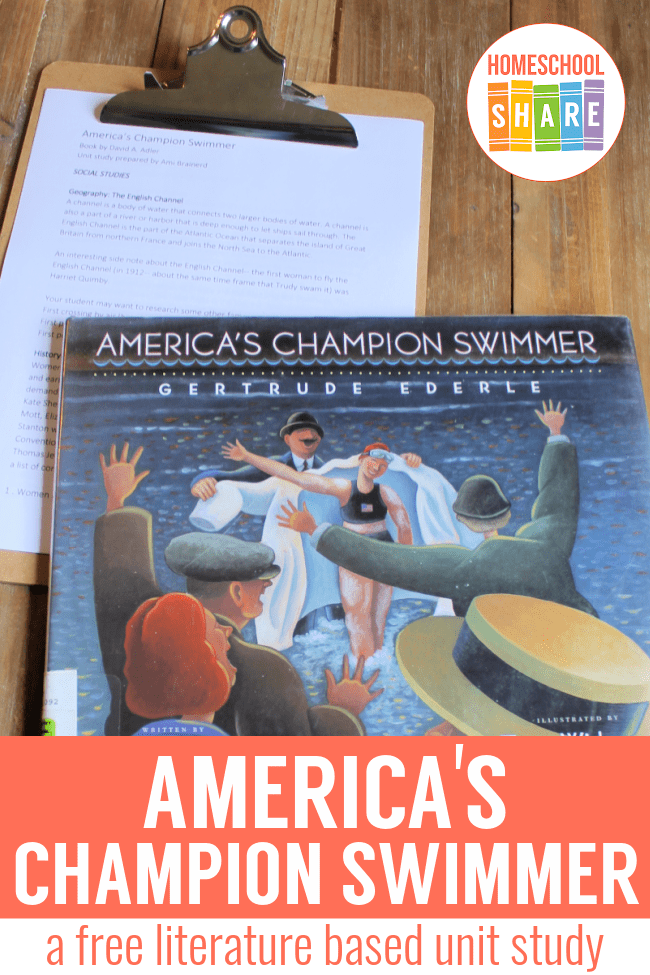
America's Champion Swimmer
Author: David A. Adler
Illustrator: Terry Widener
ISBN: 0152052518
Summary: Describes the life and accomplishments of Gertrude Ederle, the first
woman to swim the English Channel and a figure in the early women's rights
movement.
SOCIAL STUDIES
Geography: New York City, Germany, Paris
Three different locations are mentioned throughout this story. You may
want to place a story disk in each one and connect them with string (or just
choose one place such as the English Channel).
New York City
New York State Glossary
New York State Map
Germany
Flag of
Germany
Label Map of
Germany
Outline Map of Germany
Paris, France
Outline
Map of France
Flag of France
France Map
Quiz
Geography: The English Channel
A channel is a body of water that
connects two larger bodies of water. A channel is also a part of a river or
harbor that is deep enough to let ships sail through. The English Channel
is the part of the Atlantic Ocean that separates the island of Great Britain
from northern France and joins the North Sea to the Atlantic.
An interesting side note about the English Channel-- the first woman to fly
the English Channel (in 1912-- about the same time frame that Trudy swam it) was
Harriet Quimby.
Read
More about Harriet Quimby
Your student may want to research some other famous English
Channel crossers!
First crossing by air (hot air balloon) -- Jean-Pierre Blanchard
First person to swim the channel-- Matthew Webb
First person to cross the channel in a heavier-than-air aircraft-- Louis Bleriot
History: Women's Rights Movement--Women's Suffrage
sources: www.wikipedia.com
, http://edsitement.neh.gov
Women's Suffrage (women's right to vote) was a major movement of the late 19th and early 20th centuries, with suffragists protesting vigorously for many
years, demanding equality with men, and the right to vote. Prominent suffragists
include Kate Sheppard, Sojourner Truth, Susan B. Anthony, Emmeline Pankhurst,
Lucretia Mott, Elizabeth Cady Stanton and later Alice Paul, and Lucy Burns.
Elizabeth Cady Stanton wrote a Declaration of Sentiments for the first Woman’s
Rights Convention, held in Seneca, New York, in 1848. She based the document on
Thomas Jefferson’s Declaration of Independence. Like Jefferson, Stanton included
a list of complaints including the following:
1 . Women had to obey laws created without their input.
2 . Women could not attend college.
3 . Married women were, for all intents and purposes, legally dead.
4 . Women were not allowed to vote.
5 . Women’s self-esteem was ruined due to their treatment at the hands of men.
6 . Women had fewer rights than men with low morals and men who were not
citizens.
7. Unmarried women were taxed with no say in how the money was to be spent.
8 . Women could not be ministers, doctors, or lawyers. Women’s work was
low-paying.
9 . Women in divorce cases had no say over matters such as who would raise the
children.
10 . A married woman had no rights to property or the money she earned.
11 . Men were given complete control over and responsibility for their wives .
12 . Men were unrightfully “playing God” by deciding what was appropriate for
women.
13 . Because women could not vote, they could be more easily exploited.
14 . Women were not allowed to hold important positions in the church or the
state.
15 . There was a different standard of behavior for men and women.
This can be a highly sensitive topic, but I would encourage you to help your
student form a clear understanding of what the Word of God says about the roles
of a man and a woman. You can help your student shape a word view
based on the Bible.
This Worksheet Guide (pdf file) has some good critical thinking
exercises for you to go over with your student. Decide, together (based on
the Word of God), in what ways was Elizabeth Cady Stanton valid? In which
ways was she wrong? What is the Biblical role of a woman? a wife?
a man? a husband?
Modern feminism and most modern sociological theory maintain that the
differences between men and women are, at least in part, socially constructed
'differences' , (i.e. determined through history by specific human groups),
rather than biologically determined, immutable conditions. Do you
agree with modern feminism, or, are there differences between how God made women
and how God made men?
Go-along book The Ballot Box Battle by Emily Arnold McCully
History: Important Women in History Project
If your student is interested in other women who have been important in
history, consider one of the following project ideas:
1. Using the list of names below, create a time-line of women in history.
2. Using the list of names below, choose one for research and write an
essay on the life of that woman and why she was important to history.
Include information such as life story, the impact that person had on history
(was it good or bad?), etc.
3. Create a small book of Important Women in History. Design a cover
page and write a paragraph for each women chosen to be included in the book.
You could even include other women you've studied that may not be mentioned
below (such as Fanny Crosby or Wilma Rudolph). Encourage your student to
find pictures to place at the top of each entry and to type their paragraphs.
You may even want to take this to an office supply store and have the end result
bound with a comb binder.
Here is a list of names (with brief descriptions) to get your student started:
Louisa May Alcott (1832-1888)
Produced the first book for young girls in the 19th century. She published
over 270 works; her most famous is Little Women.
Susan B. Anthony (1820-1906)
Fought for the women's right to vote.
Clara Barton (1821-1912)
Nursed Union soldiers during the Civil War. Later in her life she founded
the American Red Cross.
Elizabeth Blackwell (1821-1910)
First women to have a medical degree.
Pearl S. Buck (1892-1973)
First woman to win the Nobel Prize for literature.
Cleopatra (69-30 B.C.)
Became Queen of Egypt when she was still a teenager; known as a "shrewd"
politician who spoke nine languages.
Marie Curie (1867-1934)
Physicist whose investigations led to the discovery of radioactivity and the
element radium; first woman to win a Nobel prize.
Amelia Earhart (1897-1937)
First woman to fly across the Atlantic Ocean.
Elizabeth I (1558-1603)
During her reign (now known as the "Elizabethan Age"), England became one of the
most important nations in Europe with a powerful navy.
Grace Hopper (1906-1992)
Advanced the world of computer programming by inventing one of the first
user-friendly computer languages.
Joan of Arc (1412-1431)
She thought that her "divine mission" was to free her country, France, from
England. She led French troops to victory in 1429's battle of Orleans.
Jackie Joyner-Kersee (1962-)
First American woman to win Olympic gold in the long jump, won other Olympic
events as well as set the world record for the heptathlon (a series of six
demanding events)
Hellen Keller (1880-1968)
Deaf, mute, and blind, Hellen Keller learned to overcome her disabilities and
became an expert author and lecturer.
Mother Theresa (1910-1997)
Founded a group of nuns in India and devoted her life to helping others.
Rosa Parks (1913-)
Set in motion the Montgomery Bus Boycott when she refused to give her bus seat
to a white person. This event was a cornerstone of the civil rights
movement.
Sally Ride (1951-)
The first American woman in space.
Eleanor Roosevelt (1884-1962)
Human rights champion who worked to further rights for women, black people, poor
people, and the unemployed.
Sacagawea (1787-1812)
Interpreter for Lewis & Clark during the exploration of the Northwest.
Margaret Thatcher (1925-)
First woman in European history to be elected prime minister.
Harriet Tubman (1820-1913)
Born a slave who eventually became a conductor on the Underground Railroad; she
led over 300 slaves to freedom.
--information from
Scholastic Website Women in History
Human Relationships: Encouragement
Encouragement is when someone causes someone else to feel courage, spirit, or
hope.
In what ways did Trudy's sister, Margaret encourage her throughout Trudy's
swimming career? Discuss these with your student. Can your student
think of someone she can be an encouragement to? (a sibling, a grandparent, a
friend?) How can she help someone feel courage, spirit, or hope? Can
you be an encouragement to your student? Think of practical ways to
encourage your student to pursue her talents.
Character Building: Determination
A person who is determined has firm or fixed intentions. Someone who isn't
going to give up; someone who is going to reach their goals. Trudy was
determined.
"...it didn't matter what people said or wrote. She was going to swim the
Channel...Trudy did not give up her dream. She found a new trainer, and a year
later...was ready to try again." As Christians, what should we
determine to do? Discuss this with your student. Pray with your
student that God will give him determination to do what is right even in the
face of temptation. You may also want to discuss other areas of life that
require determination.
Government: Mayor and President
(information summarized from
http://bensguide.gpo.gov *a great
website!)
This book mentions a mayor and a president and lends itself to introducing
the concept of American government to your student.
After the American colonies won their independence from England, the thirteen
colonies became thirteen states. The new states formed a league so they could
work together. Their system of government was described in a document called the
Articles of Confederation. In this system, the state governments had most of the
power. The national government was very weak. This was very different from the
government under the King.
Once the thirteen American colonies broke free from England, they became states
and started working together. They wrote up a document (the Articles of
Confederation) in which the state governments had the majority of the power
leaving the national government very weak. They wanted a system very
different than the one they were used to (with a King being in charge).
However, The Founding Fathers saw that this system left the nation too weak and
wrote up a new document (the Constitution). The Constitution divided the
power between the national and state governments.
National Government
The Founding Fathers (while framing the Constitution) wanted to form a
government that did not allow one person (such as a King) to have too much
control. They wanted to divide the power. First, they wanted the
states to have a certain amount of power as well as the national government.
They separated the national government's power into what we call three branches.
Each branch has its own responsibilities while working together to make the
country run smoothly. Each branch is accountable to the other branches to
insure that the power stays balanced.
The three branches of the U.S. Government are the
legislative,
executive, and
judicial.
Branches of
Government Diagram
More Detailed Diagram
State Government (and Local Government)
Not only is there a national Constitution; each state has its own
constitution based on its unique history, needs, philosophy, and geography. A
state's constitution is similar to that of the national Constitution; however,
the laws made in individual states cannot conflict with the national
Constitution or national laws. The national Constitution is "the supreme law of
the land."
Each state's constitution also separates power between three branches --
legislative, judicial, and executive. In addition, in most states, the
legislative branch contains two houses. Instead of a president, each state
elects a governor.
The third type of government is local governments. Most Americans live under the
national government, a state government, and several local governments. Local
government is divided into five categories:
County
Town and Township
Municipality
Special District
School District
If your student is interested in government (or if it's election time),
allow him to research more about your local candidates. Who would he vote
for? Why? (You could also discuss who you are going to vote for and
why.)
Symbolism: The American Flag
The colors on the flag symbolize: red - valor and hardiness, white-innocence
and purity, and blue stands for vigilance, perseverance, and justice.
Discuss the different qualities with your student. Why is it important
for our nation to be founded on valor, purity, justice, etc.? Does our
nation still represent these character traits?
valor-
personal bravery in the face of
danger
hardiness- bold, brave
innocence-
free from guilt or blame
purity-
freedom from guilt or sin
vigilance-
alert to signs of danger
perseverance-
to keep at something in spite of
difficulties, opposition, or discouragement
justice-
being in agreement with a standard
of correctness
History of the flag
No one knows for sure who it was that designed the first stars and stripes
or who made the first flag. However, design credit is usually given to
Francis Hopkinson and Betsy Ross may have sewn the first flag, but this is
unlikely.
June 14, 1777- Congress passed the First Flag Act in order to establish an
official flag for the new nation. It was to be made of thirteen stripes
(alternating red and white); there were also to be thirteen stars (white in a
blue field).
Have your student research how many stripes and how many stars are on the flag
today. Why? (There are 50 stars-- each one represents a U.S. state;
there are 13 stripes-- each one represents one of the original 13 colonies.)
Learn The Pledge of Allegiance
APPLIED MATH
Make a Time Line (of Trudy's Life)
In order to complete this project, your student will need to start with 1906 and
determine what year the next even happened.
For example
1906- October 23-- Trudy was born
now, your student needs to add seven years to that date to find the next point
on his timeline in order to continue
born October 23, 1906
at age seven- she fell into a pond and nearly drowned
at age thirteen- she became a member of the New York Women's Swimming
Association
at fifteen- Trudy won her first big race
the next year (age 16) she attempted to be the first woman to swim the more than
seventeen miles from lower Manhattan to Sandy Hook, New Jersey
in 1924 she made the U. S. Olympic team and won three medals
1925- Trudy had set 29 U.S. and world records
August 18, 1925- first attempt at the channel
August 6, 1926- second attempt at the channel
Story Problems
When Trudy went to swim the Channel (20 miles wide) her trainer pulled her out
with less than 7 miles to go. How far had she gone?
She started her second attempt across the channel at about 7 a.m.
She ate her first meal at 10:30 a.m.
At about 1:30 in the afternoon, it started to rain.
by 6:00 p.m. the tide was stronger
at 9:40 p.m. she made it!
Based on the above information, answer the following problems
How much time passed from when Trudy started her adventure until she ate her
first meal?
How much time passed from Trudy's first meal until she finished?
How much time between the beginning of the storm until the tide grew stronger?
Trudy swam the channel in fourteen hours and 31 minutes beating the men's time
by (almost) 2 hours. What was the best time for men?
Measurement
The waves were twenty feet high - measure 20 feet with your student
SCIENCE
Biology: Sea Creatures
This book mentions both jellyfish and sharks. Let your student
research (check out books from the library or use links below) these wonders of
the ocean. Would Trudy want to have an encounter with either one?
Why not?
Ocean Currents
What causes ocean currents? An ocean current is a permanent or
continuous, directed movement of ocean water that flows in one of the Earth's
oceans. The currents are generated from the forces acting upon the water like
the earth's rotation, the wind, the temperature and saltiness, and the
gravitation of the moon. In the demonstration, your student will
observe how wind, temperature, and saltiness effect currents.
Learning about Currents Demonstration
Adapted from Ready-to-Use Earth Astronomical Science
Activities for Grades 5-12
Materials Needed:
Tin pie plates
Water (cold and hot)
Oregano
Plastic straw
Food coloring
Tablespoon and teaspoon measuring spoons
Table salt
Procedure:
1 Fill a tin pie plate to the inner rim with cold tap water.
2. Sprinkle a teaspoon of oregano over the surface.
3. Using a plastic straw, gently blow across the middle of the surface from one
side of the pan.
4. Ask your student to describe the pattern created by the motion of the
oregano. (Student should observe that the water is rippled by the artificial
wind they create and that the currents on the surface circulate around the edges
of the pan.)
5. Point out that the wind they created is analogous to the Equatorial Currents
flowing west at the Earth's equator. These currents are forced into a clockwise
rotation in the Northern Hemisphere and a counterclockwise rotation in the
Southern Hemisphere because of the Earth's rotation and the landmasses that
obstruct the waters' flow.
6. Heat some water until it is hot. In a separate container, add three
tablespoons hot water, a tablespoon of salt, and several drops of food coloring.
Stir the mixture.
7. Carefully pour the warm mixture into the pie plate with the cold water.
What happens?
8. Ask your student to describe how this denser mixture behaves when
poured into cool water.
9. After you finish with this demonstration, you may want to have your
student label the major ocean currents on a map of the world. Use red
lines for the warm currents and blue lines for the cool ones.
Ocean
Currents of the World
World Outline Map to mark currents (you may have to enlarge)
Health: Water Safety
To protect Trudy from icy cold water, Margaret coated her sister with lanolin and
heavy grease. Why would Margaret put lanolin and grease on her sister?
What was she trying to protect her from? Swimmers can get hypothermia
(dangerously low body temperature) in cold water.
Try the following demonstration with your student.
You will need
a bucket or tub
cold water and lots of ice
a thermometer
Crisco (or any brand of shortening)
Latex Gloves
Fill the tub with ice cold water and check the temperature. Have your
student place his hand in the water for a few seconds. Is it freezing?
It should be! Now, have him put on a latex glove and cover it with
shortening. Check the temperature again to see if it's just as cold
(or colder) Have him put his protected hand back in the ice cold water. Is
it freezing?
You may also desire to discuss the following rules with
your students as applicable for your family.
Rules for Boating Safety
Know your boat -- each boat has its own purpose. Make sure you use your boat
correctly.
Always wear a life jacket while riding on a boat.
Make sure an adult is operating the boat.
Don't stand while a small boat is moving
Don't sit on the gunwale or bow of a moving boat.
Also, it's a good idea to know your state's laws governing boating and fishing.
Rules for Swimming Safety
Learn to swim.
Always swim with a buddy.
Make sure an adult (or lifeguard) watches you.
If you can't swim, or if you are just learning to swim, wear a life jacket.
Don't use an inflatable air mattress or swim ring unless you know how to swim.
Don't swim in cold water-- it can cause dangerously low body temperature
(hypothermia).
Never dive or jump into unknown waters.
Obey all "No Swimming" and other warning signs.
Ears and Hearing
Read the note at the end of the story. What happened to Trudy's ears
as a result of swimming the channel?
If your student desires to learn more about ears, let him do some research, or
see lessons in another HSS unit-- Tea With
an Old Dragon.
LANGUAGE ARTS
Genre: Biography
This word comes from the Greek words bios meaning "life" and
graphein meaning "write". A biography is the written account of an
individual life.
Writing Assignment: Biography
Challenge your student to interview someone then to use the information
gathered in the interview and write a biography.
Ideas for interview questions (each section can serve as a paragraph topic).
After your student has collected information, encourage him to only use what he
needs--the best information-- to write the biography (every detail probably
won't be necessary).
1. Birth Facts
Where were you born (city and or hospital name)?
What are your parents' names?
How much did you weigh?
Is there other information about your birth that you'd like to share?
2. Childhood
Where did you go to school?
What was your favorite subject? Why?
What subject was the most challenging?
Are there any funny stories you have to tell about your school days?
Who were your friends?
What were your favorite things to do? (Ask for descriptions of games and
such if they are from another time)
What were your favorite books of childhood?
What else do you remember about your childhood that you'd like to share?
3. Family
Did you have any siblings (brothers? sisters?)
How did your siblings help shape your life?
4. Major Events in Your Life
What would you consider major events in your life? (salvation, marriage,
birth of children/grandchildren, etc.) Please describe each one.
Were you in the military? If so, what branch and when? Peacetime or war? Any
experiences you wish to share about your time serving?
5. Major Accomplishments
Where did/do you work?
Why did you choose this occupation?
Any word of advice/wisdom for future generations?
Vocabulary
Many times, a word has multiple definitions. Find the following
words within the text of the story with your student. Then, have your
student determine which definition fits the word as used in context of the story.
Prepared Vocabulary Page
myth
1
: a story often describing the adventures of superhuman beings that attempts
to describe the origin of a people's customs or beliefs or to explain mysterious
events (as the changing of the seasons)
2 : a person or thing that exists only in the imagination
3 : a popular belief that is false or unsupported
shattered
1
: to break or fall to pieces
2 : to damage badly
prowess
1
: great bravery in battle
2 : very great ability
beacon
1
: a signal fire commonly on a hill, tower, or pole
2 : a guiding or warning signal (like a lighthouse)
3 : something that inspires
modest
1:
having a
limited and not overly high opinion of oneself and one's abilities,
not boastful
2 : moderate in amount, size, or extent
3 : clean and proper in thought, conduct, and dress
poised
1 to hold or make firm or steady by
balancing
2 : to put into readiness
ultimate
1: the farthest, last in progression
2 : arrived at as the last result
3 : incapable
of further division or separation
4 : being the greatest or most extreme
flares
1
: a fire or blaze of light used to signal, light up something, or attract
attention
2 : an unsteady glaring light
3 : a spreading outward; also : a place or part that
spreads
4 : bell-bottom pants
Creative Writing: Newspaper Article
Read some front page newspaper articles with your student. Give him
the assignment of writing his own front page article that tells the story of Trudy's successful swim across the channel.
Go back through the book and help him answer the five w's of news
reporting-- who, what, where, when, why. You can use this
prepared page to brainstorm (or
simply count it as your activity for a younger student). After he's compiled his
answers, he's ready to start writing his article.
Italics
Review with your student that names of boats should be underlined or in italics.
This rule also applies for book titles.
ART and MUSIC
Music
The book states that "songs kept her brain and spirit good"
How does music do this? If music affects us in this way, why is it
important to listen to the right kind of music? Read Philippians 4:8.
Make a list together of the the things we are to think on. Can we apply
this scripture to the music we listen to? What happens when a person
listens to music that focuses on the negative, the impure, and things that are
untrue?
Lyrics and music for East Side, West Side
Music:
"The Star-Spangled Banner"
(brief history information from www.wikipedia.com)
The Star Spangled Banner was one of the songs that kept Trudy going. Does
your student know this song?
Brief History: "The Star-Spangled Banner" is the national anthem of the United
States of America, with lyrics written in 1814 by Francis Scott Key. Key, a
35-year-old lawyer and amateur poet, wrote them as a poem after seeing the
bombardment of Fort McHenry in Baltimore, Maryland, by British ships in
Chesapeake Bay during the War of 1812. In 1916, Woodrow Wilson
ordered that "The Star-Spangled Banner" be played at military and other
appropriate occasions. On March 3, 1931 by President Herbert Hoover signed
a law adopting "The Star-Spangled Banner" as the national anthem of the United
States.
Read and discuss the lyrics with your student.
"Star-Spangled
Banner" Music
Lyrics:
O say, can you see, by the dawn’s early light,
What so proudly we hailed at the twilight’s last gleaming,
Whose broad stripes and bright stars, through the perilous fight,
O’er the ramparts we watched, were so gallantly streaming?
And the rockets’ red glare, the bombs bursting in air,
Gave proof through the night that our flag was still there;
O say, does that star-spangled banner yet wave
O’er the land of the free and the home of the brave?
On the shore, dimly seen thro’ the mist of the deep,
Where the foe’s haughty host in dread silence reposes,
What is that which the breeze, o’er the towering steep,
As it fitfully blows, half conceals, half discloses?
Now it catches the gleam of the morning’s first beam,
In full glory reflected, now shines on the stream
’Tis the star-spangled banner. Oh! long may it wave
O’er the land of the free and the home of the brave!
And where is that band who so vauntingly swore
That the havoc of war and the battle’s confusion
A home and a country should leave us no more?
Their blood has washed out their foul footstep’s pollution.
No refuge could save the hireling and slave
From the terror of flight, or the gloom of the grave,
And the star-spangled banner in triumph doth wave
O’er the land of the free and the home of the brave.
Oh! thus be it ever, when freemen shall stand
Between their loved homes and the war’s desolation,
Blest with vict’ry and peace, may the Heav’n-rescued land
Praise the Pow’r that hath made and preserved us a nation!
Then conquer we must, when our cause it is just,
And this be our motto: "In God is our trust."
And the star-spangled banner in triumph shall wave
O’er the land of the free and the home of the brave.
More Lessons on
"The Star-Spangled Banner"
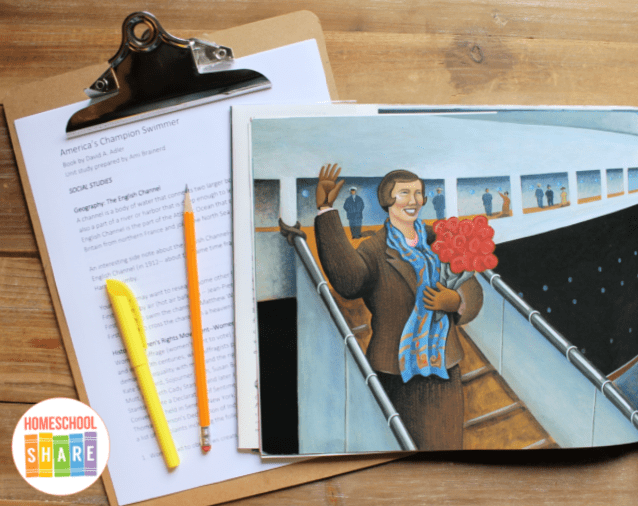
Art: Detail
Notice the kind of brush strokes (almost like dots) the illustrator used to
make the water, the sand on the beaches, and the background people in the
parade. Do you see these brush strokes anywhere else in the
pictures?
Materials and information on this website belong to the original composers. It may be used for your own personal and school use.
Material may not be used for resale. © 2005-07 HSS