| about us |
what's new
|
unit studies
|
unit study helps |
fiar resources
|
indexes | lapbooking |
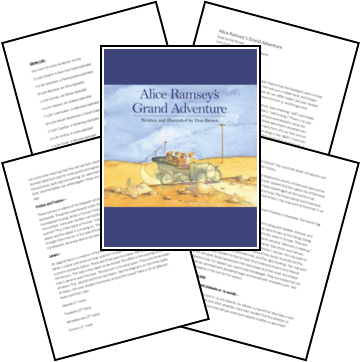
Alice Ramsey's Grand Adventure
| Author: Don Brown ISBN:0618073167 Summary: Describes the difficulties faced by the first woman to make a cross-country journey from New York to San Francisco in an automobile in 1909. |
Level 3 lessons by Debbie Palmer
Any Hans Christian Anderson stories (The Emperor’s New Clothes, The Little Mermaid, The Ugly Duckling)
E is for Empire: A New York State Alphabet
K is for Keystone: A Pennsylvania Alphabet
B is for Buckeye: An Ohio Alphabet
L is for Lincoln: An Illinois Alphabet
H is for Hoosier: An Indiana Alphabet
C is for Cornhusker: A Nebraska Alphabet
M is for Mount Rushmore: A South Dakota Alphabet
C is for Cowboy: A Wyoming Alphabet
A is for Arches: A Utah Alphabet
S is for Silver: A Nevada Alphabet
G is for Golden: A California Alphabet
Atlas
Draw Write Now book 1
Draw Write Now book 5
Charlotte’s Web by E.B. White
Number the Stars by Lois Lowry (for an older student-Set in Denmark during WWII)
History of the Automobile –
How is the Maxwell described in the book? Notice that the headlights were torches that needed to be lit with a match. The horn was just a rubber bulb, and the gas tank was located under the front seat. How do cars differ today? Ask your student how the headlights come on and work, where the horn is, and the gas tank.
The automobile is made up of two Greek words: auto (meaning “self”) and mobils (meaning “moving”). Therefore an automobile is “self-moving”! There is no one inventor of the car. Many men over a period of time contributed to what the automobile is today. In the 1700’s and 1800’s there were steam-powered cars (although not many of them!). In the 1800’s, an early form of a car that runs on electricity was designed. Gas-powered cars came along in the 1800’s. It was Karl Benz (from Mercedes-Benz fame) who designed the world’s first practical car. It had only three wheels! But it was Henry Ford who made the car accessible to many people by creating an assembly line to build his cars. The Maxwell brand of car (like the one that Alice drove) was in production from 1904-1925. Your older student may want to do more research on Benz or Ford.
United States Geography (Alice Ramsey’s route) –
Using the United States Outline Map provided, trace Alice Ramsey’s route. Have your student color in the states that are mentioned in the book that Alice traveled through. You will notice that not all the states are mentioned because there are some “gaps”. What other states can you student safely assume Alice passed through?
There are several states mentioned in the story. This would be a good time to practice finding all these states, helping your student on his/her way to eventually learning the location of all the states.
Other information that might be important for your student to know would be the capitals of the states mentioned. Here is a list of the states (that are mentioned in the book) and their capitals. Can your student also find the capitals of these states on a map? You could also take index cards and print the name of each state and capital on the cards. You and your student could then play memory by trying to match the capital with the correct state.
New York-Albany
Pennsylvania-Harrisburg
Ohio-Columbus
Indiana-Indianapolis
Illinois-Springfield
Nebraska-Lincoln
South Dakota-Pierre (pronounced “peer”)
Wyoming-Cheyenne
Utah-Salt Lake City
Nevada-Carson City
California-Sacramento
You could also introduce to your student the fact that each state in the Union has its own nickname. Explain that a nickname is not the official name of the state, but another name that it goes by. Does your student have a nickname that he/she goes by? The nicknames of the states are in some way related to the state or describe it. For an older student you might want to have them research why each state mentioned has that certain nickname. For example: Wyoming is the Equality State because it was the first state that allowed women to vote. Here are the nicknames for the states in the book
New York-The Empire State
Pennsylvania-The Keystone State
Ohio-The Buckeye State
Indiana-The Hoosier State
Illinois-The Prairie State
Nebraska-The Cornhusker State
South Dakota-The Mount Rushmore State
Wyoming-The Equality State
Utah-The Beehive State
Nevada-The Silver State
California-The Golden State
In the Go-Along section above there is a list of books that relate to each state (i.e. E is for Empire). You might want to pick out a couple of them to read and focus on a few of the states.
Geography (Denmark) –
On page 19 there is mention of a family that only speaks Danish. Alice and her companions have to seek shelter there from the storm. Why would there be a family in the US that only speaks Danish? You could talk about immigrants and where they came from early in our history.
This would be an excellent time to explore the country of Denmark. Here is outline map of the country. Using an atlas, have your student find the capital city of Denmark, which is Copenhagen. Have him/her label Copenhagen on the outline map. Denmark also has two autonomous provinces: the Faroe Islands and Greenland. (The Faroe Islands are due north of Great Britain.) You may want to find them in an atlas.
Here is the flag of Denmark. Your student may color the blank one if he/she is interested. The Danish flag is the oldest country flag in Europe.
Denmark is considered a Scandinavian country along with Sweden, Norway, and Finland. From the 8th-11th centuries the Danes were known as the Vikings (along with the Swedes and Norwegians) and raided many areas in Europe. They also went exploring to places like Greenland and North America. Denmark is made up of a large peninsula called Jutland and many islands. One of the most famous Danes is Hans Christian Anderson, a writer of children’s stories. You may want to read some of his stories to your student. Some of the stories he wrote are The Emperor’s New Clothes, The Little Mermaid, and The Ugly Duckling. You may want to introduce your student to Danish food. One traditional food is Smorrebrod, which are open-faced sandwiches that have bread and then meat and cheese placed on top. For dessert you could make Pandekager. They are crepes that are rolled up, sprinkled with powdered sugar and served with strawberry jam. See recipe below in the Just for Fun section.
Parts of Speech (Adverbs or –ly words) –
Many words that end in –ly are adverbs. An adverb is a word that describes a verb (and also adjectives and other adverbs). Have your student find the adverbs (-ly words) in the story. Can they tell you what each adverb modifies or describes? Watch out though! Not all words that end in –ly are adverbs (i.e. the word “family”). Here is the list of the adverbs in the story, the page number where they are found and the word they modify or describe.
slowly (8) revealed
gingerly (10) waded
carefully (15) drove
suddenly (15) plunged
mightily (16) strained
eventually (18) rejoined
quickly (26) wanted to cross
wildly (30)
honked
Giving directions –
Alice uses the Blue Book in order to find her way around during the eastern part of the trip. But directions are useless if they are confusing or plain wrong (i.e. “Turn left at the red barn with the yellow silo”, but the silo is blue). For fun, see if your student can give good directions. This activity will only work with an older child who knows his/her way around your neighborhood. Adapt the exercise to fit your child’s abilities. Get in the car and drive to a spot that is familiar to your child. Then ask him/her to give you directions on how to get home. Follow only the directions that the child gives you. Did you make it home? Another fun idea that requires some advance thinking on your child’s part (the child would need to be older, say 8 or up) is to drive to a spot and then tell the child that you can only make right-hand turns to get home. Can they direct you? It may take several tries, but it is doable
black sort (sord)
white hvid (vidh)
gray grå (gruh)
red rød (ruhdh)
blue blå (blor)
yellow gul (gool)
green grøn (grurn)
orange orange (oran'ge)
purple lilla (leela)
brown brun (broon)
Perspective –
Have your child look at the watercolor illustrations. Does your child notice that the items in the backgrounds have less detail in them and are smaller? For example, on page 9, there is a picture of the car going over the tracks…in the background is a city and a train. Ask your child if a train and a city are bigger than a car? Why are they smaller in the picture? This is perspective…. things that are farther away are drawn smaller and with less detail to give the impression of depth to the picture. Have your child find more pictures like these in the book and then have him/her practice this technique by drawing a picture.
Shadows –
Have your child go through the book and find the shadows. There are shadows under each picture of the car. What creates a shadow? There is normally a light source that is blocked by an object and then the object casts a shadow. Can your child tell you where the light source is coming from in each picture by looking at the shadows? Have your child practice making shadows in his/her drawings
Drawing Night Scenes –
Look at the picture on pages 26-27 with the dark blue background and the white highlights. Have your child practice this technique. Give them a dark blue or black piece of paper and some white chalk. Can they draw their own car with its headlights on? Or he/she could draw a candle in the dark or a picture of a house with the porch light on.
Draw Write Now –
If you have the Draw Write Now books there are several pictures that your student could work on that are related to the book.
Draw Write Now book 1 page 12-pigs
Draw Write Now book 1 page 22-barn
Draw Write Now book 5 page 52-car (Model T)
Pigs –
In Illinois, Alice ran into a herd of pigs. Pigs are also called hogs or swine. They have a reputation for gluttony and dirtiness, but actually they are quite intelligent. Pigs are omnivores meaning that they will eat both plants and meat. Pigs can be domesticated and used for meat (pork) and leather. There are still wild pigs such as the wild boar, bush pig and warthog. An adult female is called a sow. The male is a boar, and the babies are called piglets. There are many breeds of domesticated pigs. If your child is interested, he/she can check out this website http://www.ansi.okstate.edu/breeds/swine/ which has information on various breeds.
Friction and Traction –
There are two incidents of the Maxwell not being able to move or slipping backwards. The group used boards under the tires to gain some traction to keep the Maxwell moving. What is friction? Friction is the force of two objects coming into contact. Have your student rub his/her hand together. Do they feel the warmth? This is the result of friction. Traction is the friction between a moving object and the object it is moving on. Tractors, cars, and trucks all gain traction through their tires (or in the case of tractors, their tracks). By putting boards under the Maxwell, Alice was able to achieve traction to make the car move ahead.
Levers –
On page 6 there is a mention of the levers that Alice had to use to work the car. What is a lever and what are they used for? A lever is a rod or arm that tilts around a pivot to produce motion. There are three parts to a lever: the load, the effort and the fulcrum. The load is the object to be moved. The effort is the pushing or pulling that is done to work the lever. The fulcrum is the pivot point. There are three types of levers: first, second and third class levers. See here for diagrams on the three types of levers. Can your student find levers around the house? Here is list of different levers and their class.
Seesaw (1st class)
Tweezers (3rd class)
Wheelbarrow (2nd class)
Scissors (1st class)
Fishing rod (3rd class)
Stapler (3rd class)
Oars- when used to move water (1st class)
Mousetrap (3rd class)
Baseball bat (3rd class)
Miles per Hour –
What was the top speed of the Maxwell? (42 miles per hour) Does your child know what the speed limit is in most areas in this town? Go over that there are different speed limits depending on if it is a residential area, downtown, or the freeway.
Months –
Alice’s trip went from June 9th through August 7th. For younger students some good counting practice would be to pull out a calendar and count how many days are between those two dates. It took Alice 59 days to make the trip. How many months is that approximately? Explain to your child that most months have 30 days, but not all. It might be helpful to have your child memorize the following poem.
Thirty days hath
September,
April, June, and November;
February has twenty-eight alone.
All the rest have thirty-one,
Excepting leap year, that’s the time
When February has twenty-nine
Alice was born in 1887. How old was she in 1909? (22 years)
On page 28, it mentions that it took 8 hours to travel seventy miles. How many miles per hour is that? (8 ¾ miles per hour)
Alice was born in 1887 and died in 1983. How old was she when she died? (96)
Just for Fun
Recipe- Pandekager (Danish Pancakes) –
It may be fun while sharing this book with your child to make some Danish Pancakes. Many recipes for Pandekager call for beer. These however do not!
1 ½ cups milk
3 large eggs
3 T. sugar
1 t. salt
5 T. butter, melted
1 t. vanilla
1-cup flour
In blender combine ingredients and mix until foamy. Using a non-stick sauté pan coat it with a small amount of butter. Pour ¼ to 1/3 cup batter into the pan. Tilt the pan in all directions to spread a thin layer of batter across the bottom. Pour in just enough batter to cover the pan. Cook until bubbles begin to form on surface. Lift and flip (I use a spatula to release the edges and then I grab the pancake and at one edge and pull it off and flip it.) Cook another minute or less on the other side. Serve with powdered sugar and strawberry jam.
Materials and information on this website belong to the original composers. It may be used for your own personal and school use.
Material may not be used for resale. © 2005-07 HSS