| about us |
what's new
|
unit studies
|
unit study helps |
hss resources
|
fiar resources | indexes | lapbooking |
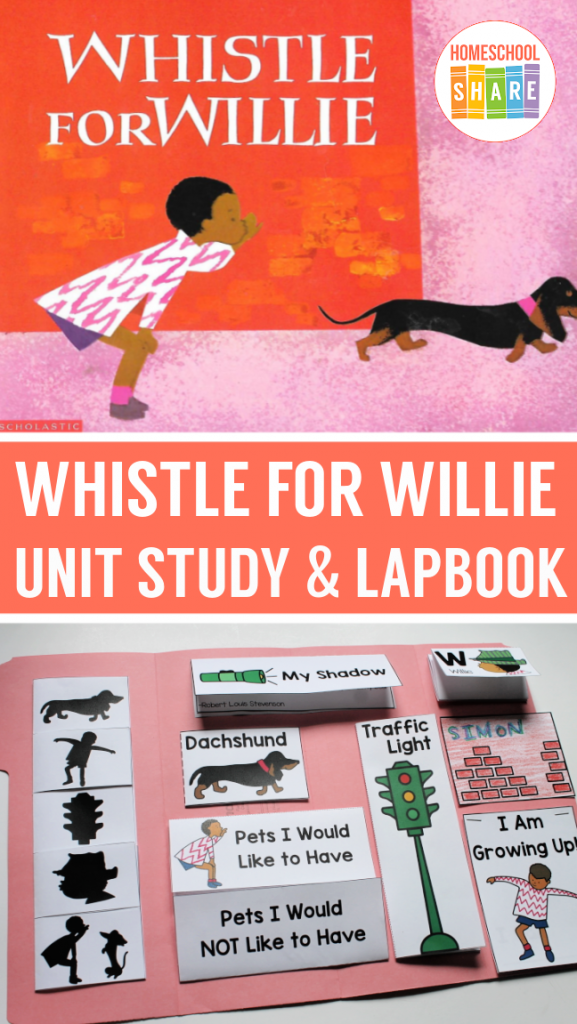
Whistle for Willie
|
Ezra Jack Keats ISBN: #0140502025 Unit Study prepared by Kristina Johnson
|
Language Arts
Letter Recognition
1. The letter “W” Cut out a large W and hang it over a table and encourage your child to find things that start with “w” throughout the house and place them on the table. Examples: something white, whistle, wallet, water, watch, whale toy or picture in a book, white out, etc.
2. Graffiti – On the page where
Peter is trying to run from his shadow, spend some time looking at the wall.
Has your child ever seen graffiti? Is there any in your neighborhood? (note:
this can be a good springboard for a discussion of respecting the property of
others.) Notice the letters. Can your child name them? Are there any letters
that are in his/her own name?
Story Writing
Ask your
child to dictate or write a story to you about whistling for their own dog (or a
dog they’d like to have). What would happen, what would the dog look like,
what
would you do if you couldn’t whistle, how else could you call a dog? Are
there other animals that would respond to a whistle?
Opposites and Positional Words
Teach or review opposites and
positional terms using a cardboard box. In/out, on/under, in front of/ behind,
next to etc. Let your child use his body to demonstrate knowledge of the
words. You might also use a stuffed animal.
Character
Peter is in
several other of Keats’ stories: The Snowy Day, Peter’s Chair, Letter to Amy,
Goggles and Hi Cat. Check these titles out of the library and read them. Have
your child continue Peter’s story by dictating or writing another one.
Make a book
Make a book about growing up. Discuss what Wilie wanted to do
(whistle). What does you child want to do? Focus on those things
that he CAN do!
I am growing up...
I can...
I can...
I can...
I can't.....yet, but someday I will!
Contractions
For older
student- identify contractions as you read the story. (couldn't, he's, wouldn't,
it's, etc.)
Math
Patterns
File Folder
patterning game with objects found in story
Whistle
for Willie File Folder Game
Graphing
Visit a pet
store. Look for the dachshunds. How many are there? How many other kinds of
dogs (breeds) are there? Count the number of each breed. At home, create a
bar graph or pie chart. Which breed did the pet store have more of? Less of?
Halves and
Fourths
Break one graham cracker in half, then in half again. Talk about how
one piece becomes 2 (half) and then 4 (one fourth). Note: For a treat, spread
peanut butter on each piece and top with one yellow, red and green m&m (leftover
from social studies lesson) to make a traffic light. You could also use colored
icing if peanut allergies are a concern.
Social Studies/History/The World Around Us
Neighborhood and
Your Town
We see much
of Willie’s “world” in the story. Take a walk around your own neighborhood.
What does he see? Are there houses? Apartments? Stores or other businesses? Do
the homes look the same? What is different about them?
Are there any traffic lights? Do you see any graffiti?
Take a walk around your town square or a downtown area. Are there homes? Encourage your child to look up. Many buildings have apartments or offices above street level stores. What kinds of stores/businesses does he see? Can he tell by looking at the sign what sort of business/store it is? What kinds of people does he see? Are they dressed alike? Can you tell what sort of job they do by the way they are dressed? Are there any traffic signals? If not, are there any other safety signs? Do you see any graffiti? What about a barber pole? If you pass any fabric, wallpaper or paint stores, go inside and ask for samples (you will use these in an art collage, see Art #7)
People are
Different
Is your student's skin the same as
Willie’s? Does he/she have any friends that have skin lighter/darker than
Willie’s? Many children are not exposed to people of other skin colors.
Discuss differences in people and how incredible God must be to create so many
unique and different people!
Give your child one each of several colors of m&m’s. Ask him to look at each one. What is different about them? (color) What is the same? (round, size) Now, use a knife to cut each one in ½. Is the inside of each one the same? Allow your child to eat them. Do the various colors taste any different? Use this lesson to remind your child that though a person’s skin may be different than ours, inside we are all the same. Use any leftover m&m’s for Math #1.
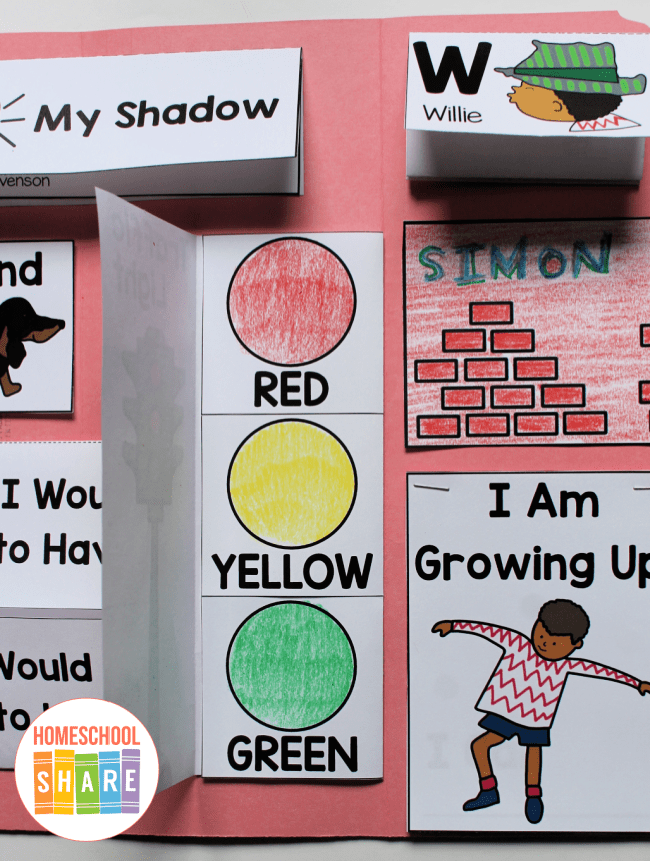
Traffic Light
The traffic
light was invented by Garrett A. Morgan. You can learn more
here. If you have not
already done so, this is a good time to discuss how to cross the street safely.
Science
Zoology: Dogs
Discuss the dachshund breed. Has your child seen this type of dog?
It is sometimes affectionately called a “hotdog dog”. Why might it be called
that? Can you think of fun nicknames for the other breeds he sees? In what
ways are dogs similar to pets he has seen? How are they different? Consider
creating a notebook about various types of pets. What do they eat? What kind of
care do they need? Do they need a cage?
Colors
Use primary colors to create
secondary colors. Experiment with the marble paper making activity (Art #8).
Use primary colored paints and slowly swirl them together. What colors do you
get? Let this activity be discovery based.
Shadows
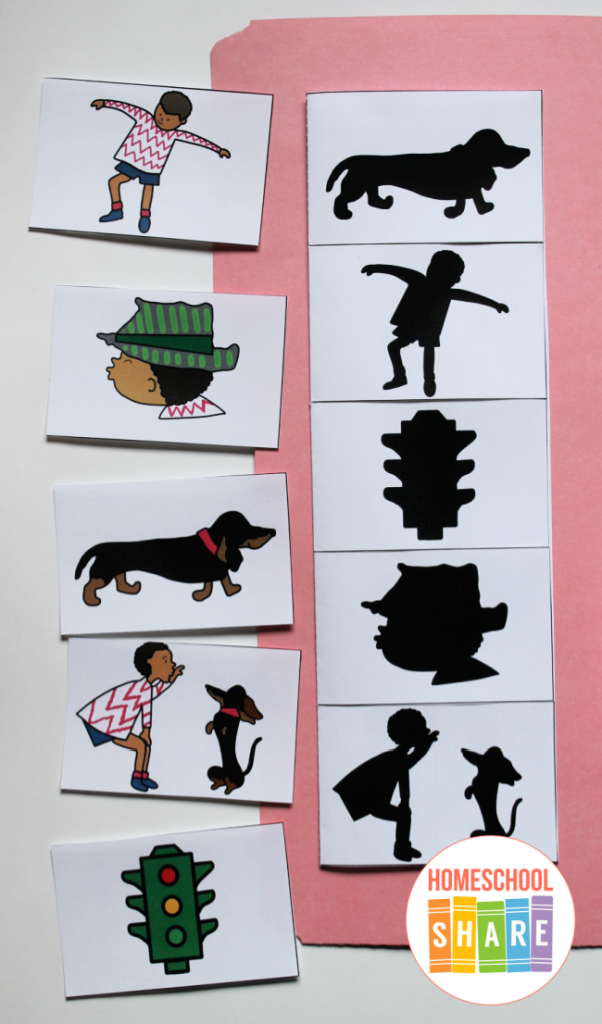
1. Using a flashlight, show your child how a shadow is created.
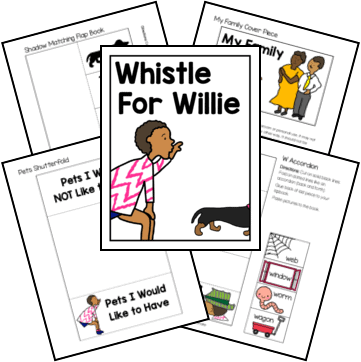
2. Print and play the Shadow matching game.
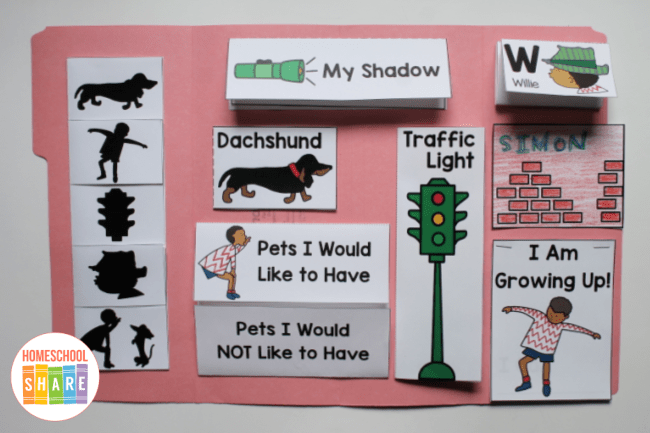
Print this page. Ask your child to find the various items in the story as you read the book. Cut out all the shapes. Help your child glue the shadow shapes onto a piece of paper Ask your child to match each item to it’s shadow. You may also wish to turn this into a flannel board or file folder game.
3. Robert Louis Stevenson wrote a poem
("My Shadow") that would be a great go-along (picture book
form ill. by Ted Rand)
Music
Whistling
Can your child whistle? Can
you? If you can whistle, try whistling a familiar tune an see if he can
identify it. Maybe dad would join in on the fun, too.
Art
1. Ezra Jack Keats often combined patterned papers and cloths with paints to make striking illustrations. Look at the illustrations together. Can your child pick out the parts that are paper, cloth, paint? Did the artist use only paint brushes with the paints?
2. Look at the brick wall on the page where the girls are jumping rope. What does your child think the artist used to create the bricks? Provide some sponges or erasers and experiment. Can your child produce the same effect? Experiment also with mixing colors to add shading.
3. Create your own patterned paper. Take plain paper and ask your child to use watercolors or stamps to create a pattern. Allow it to dry.
4. Graffiti – On the page where Peter is trying to run from his shadow, spend some time looking at the wall. Notice the letters. How does your child think the artist created them? Supply some alphabet cookie cutters or sponges, rubber stamps or foam stamps. Let your child create a similar piece of art. How can they add the mottled effect for the background?
5. On the page with the barber pole, how many different papers were used? Notice the marbled part of the collage. See science for directions to create your own marble paper.
6. Encourage your child to illustrate his story (see language arts).
7. On the page with the barber pole, how many different papers were used? Notice the marbled part of the collage. Make your own marbled paper. Fill a 13x9 cake pan with water. Add a small bit of dishwashing liquid. Drip watered down paint onto the water so that it floats. Use a straw to gently swirl the colors. The idea is not to mix them, but to just have the paint swirled on top of the water. Gently lay a piece of paper on top of the water (it works best to slightly fold the paper in half an lay the bent half first and then slowly lay the sides down). Lift the paper immediately and lay out to air dry. Experiment with different kinds of paint. Try sprinkling a little glitter onto the paint before or after it is on the paper.
8. After your walk (see Social studies) have your child use the various papers that you have created as well as any fabric/wallpaper/paint samples you collected to create a work of art similar to Keats.
Bible/Character Development
Willie is persistent in his efforts to learn to whistle. Ask your child to identify things that he has learned to do that were not easy for him (riding a bike, tying his shoes etc). Paul reminds us in Philippians of the need to keep our eyes on the prize of heaven. Persistence and diligence will serve a Christian well. What are some things that are still hard for your child? Is he willing to keep trying?
Large Motor/Physical Education
1. Jump rope
2. Invite some friends over to play “Red Light, Green Light”. One child is “it” and stands with is back to the other players that are lined up several feet away. “It” says Green light and the players run forward…until “It” yells red light and spins around. If a player is spotted moving when “it” spins around, he/she has to return to the starting line. The first player to reach “it” is the next “it”.
3. Twirl and spin, you may want to call out fast or slow.
Cooking
Traffic Lights
Make sugar
cookies with your child and cut into rectangular shapes. Create traffic signals
with green icing and m&m candies.
Peanut Butter Puppy Poppers
(Treat for your Dog!)
2 cups
whole-wheat flour
1 tbsp. baking powder
1 cup peanut butter (chunky or smooth)
1 cup milk
Preheat oven to 375'F. In a bowl, combine flour and baking powder. In another bowl, mix peanut butter and milk, then add to dry ingredients and mix well. Place dough on a lightly floured surface and knead. Roll dough to 1/4 inch thickness and use a cookie cutter to cut out shapes.
Bake for 15-20 minutes on a greased baking sheet until lightly brown. The cookies burn easily, so watch carefully. Cool on a rack, then store in an airtight container.
This recipe is
used with the permission of www.bullwrinkle.com/ Be sure to check out all the
special treats you can make for your pet.
Just for Fun
1. Online traffic light game. This is a fun way to learn what each of the colors mean.
2. Provide clothes from mom and dad’s closet.
3. Provide sidewalk chalk for outdoor fun. We like to also use it on the floor of the garage in the winter.
Learn more about the author and his other books.
http://www.ezra-jack-keats.org/
http://www.lib.usm.edu/~degrum/keats/biography.html
Ezra Jack Keats Virtual Exhibit