| about us |
what's new
|
unit studies
|
unit study helps |
fiar resources
|
indexes | lapbooking |
Aunt Flossie's Hats and Crab Cakes Later
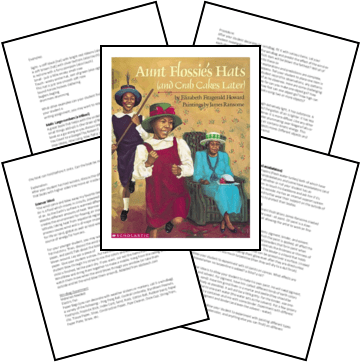
| Author: Elizabeth Fitzgerald Howard Illustrator: James Ransome ISBN: 039572077X Summary: On Sunday afternoon, two little girls visit their Great-great-aunt Flossie, whose house is full of books, pictures, and "boxes and boxes and boxes of HATS," each of which has a story to go along with it. |
Literature Based Unit Study Written by Ami Brainerd
Geography: Maryland
Maryland was the 7th state in the United States becoming a state on April 28,
1788. The capital is
Annapolis and the largest city is Baltimore. It is on the east coast of the U.S.
and major
industries include farming (corn, soybeans, tobacco, poultry and dairy
products), mining (coal),
steel products, communications equipment, and fishing (crabs and oysters).
Maryland State Bird and Flower Coloring
Page
Maryland Information
Enchanted Learning Outline map
Enchanted Learning Flag
Maryland State
Flag Print-Out
Maryland
Map/Activity Sheet
State Bird-
Oriole: Coloring and Facts
State Flower-
Blackeyed Susan Coloring and Facts
Social Studies:
Memories
Aunt Flossie shares her memories with her nieces as she shares her hats. Do you
have any memories
(pictures, mementos, journals, etc.) that you can share with your student? You
may want to arrange
a visit with grandma, an aunt, or another family member in which you go to share
memories of times
past. I know my grandma has tons of pictures from her mom's family as well as
her
dad's. She also has old quilts to share. This would be a great experience for
your student.
You can also discuss the importance of preserving memories with your student.
Why do we want to
have something to hand down to the next generation? This would be a good time to
allow your
student to start a small scrapbook. You may want to scrap one event or an entire
season (or even
an entire year) together. What a treasure that will be to hand down to your
grandchildren someday!
Human Relationships: Hospitality
Hospitality is kindness in welcoming guests or strangers. The girls are greeted
warmly by Aunt
Flossie. She says, "Come in, Susan. Come in, Sarah. Have some tea. Have some
cookies.
Later we can get some crab cakes!" How do we react when someone knocks on our
door? Are we willing and ready to give them a welcome and offer them something
to eat and or drink? We should be
hospitable to those who come to visit us. Can you and your student make a list
of special
kindnesses to give to those who visit your home?
History: Hat Fashion
No one is sure when hats were first invented.
Hats vary widely in material and style, depending on climate and customs. The
three main reasons people wear hats are protection, communication, and
decoration.
1. Protection
-- shade from the sun (Mexican sombrero)
-- extra warmth in the winter (fur or wool hats)
-- from injury (football helmet, construction hard hat)
2. Communication
-- communicate occupation (state trooper, firefighter)
-- communicate position (king, bishop, etc.)
-- communicate religious belief or affiliation
3. Decoration
--accessory for an outfit
--tradition
During the 1900s, hat styles varied more than ever before. In the
1920s women wore a drooping, bell shaped hat called a cloche, In the 1930s, they
wore a harlequin hat which had a wide upturned brim.
Many different hats were donned in the 1940s and 1950s, but in the 1960s hats
became less popular.
Some hats to research:
1200s German headdress and cap
1400s hennin
1600s European Cavalier Hat
1700s Gainsborough
1800s American top hat, American poke bonnet
Greece-- pelos
Scotland-- tam-o'-shanter
Persian turban
History: Great Baltimore Fire of 1904
http://www.mdch.org/fire/ (you MUST visit this site!)
http://www.mdch.org/fire/text-only.html (read only)
History: WWI
The soldiers returning are probably coming home from WWI (based on the Great
Baltimore Fire date). Your older student may want to dive into a study on
WWI.
Language Arts: Sensory Details
Good writers use images in their writing. An image is a concrete representation
of a sensory
experience or an object. Images allow the reader to experience the story--to
see, to feel, to hear, to taste, and to smell. Elizabeth Fitzgerald Howard has
used lots of sensory details (imagery) in her writing.
Examples:
Sight- a stiff black [hat] with bright red ribbons (also touch)
A soft brown [hat] with sliver buttons (also touch)
A red one with a furry pompom (also touch)
Smell - just a little smoky smell now
Touch- wooly winter hat, sort of green (also sight)
This hat is just one smooth soft rose
Sound-horses hooves clattering
buglers bugling
drummers drumming
What other examples can your student find in the story? The next time you give
your student a
writing assignment, you may want to require that he include some sensory
details.
Math: Large numbers (a trillion!)
A great book that helps with the understanding of large numbers (and about how
small things add up)
is One Grain of Rice by Demi. I highly recommend reading this book as a go-along
as you discuss
large numbers. Other possible go-alongs-- Can You Count to
a Googol? by Robert E. Wells and How Much, How Many, How Far, How Heavy,
How Long, How Tall is 1000? by Helen Holan.
Look at one trillion pennies! Great visual tool
Science: Buoyancy and Boats
"your favorite best Sunday hat just floated by like a boat"
Boat Buoyancy Experiment
Materials Needed: Container, Water, Ball of Clay, Pennies (optional)
Procedure:
1. Fill the container with water
2. Ask your student what will happen if you drop the clay into the container
3. Drop it in. Ask your student why he thinks the blob of clay sank.
4. Give a ball of clay to your student. Tell him to make his clay into a shape
that will float.
5. Encourage your student to keep trying until he gets a shape that floats. How
many different
shapes float?
6. For extra fun, use pennies. Count how many pennies (passengers/cargo) their
clay boat can hold
before it sinks. Can the boat be modified to hold more pennies?
Explanation:
After your student has had success, discuss the different boats he created.
Explain that boats with
higher sides trap more air inside and float better.
Use your math skills (lots of geometry) to make a floating paper boat
Science: Wind
"the wind came and blew away my favorite best Sunday hat"
Air is a fluid which moves in circuits, powered by unequal heating of large
masses of air. As the
Earth's surface is warmed differentially, the air above these surfaces absorbs
different amounts of
heat. Warmer air rises while cool air sinks which creates the environment for
flowing air movement.
Winds flow across parallels of latitude, taking heat from equatorial regions to
polar regions. This
equalizing process causes wind and is of major importance in determining the
environments for life
on land, global as well as local weather patterns, and a clean, inexpensive
source of energy for
humans.
For your younger student, you may want to check out the book The Wind Blew by
Pat Hutchins. Then,
discuss the wind and complete this activity (you need straws, paper, and paint)
Talk about the book (The Wind Blew) and the items that were blown around. Lay
out a piece of
paper. Give your student a straw. Put two blobs of paint on the paper. Have your
student blow
through his straw to mix the colors and watch them move. After the child is
finished, let the
paint dry. If you want, cut out the items from the story The Wind Blew and
string them together to
make a mobile. Hang from the ceiling and watch them move when the wind blows
through you window
(or take them outside and let the wind blow them around). Adapted from abcteach.com
Windbag Experiment
Materials Needed:
Electric Fan
Paper Bags (you can decorate with weather stickers or markers, call it a
windbag)
A variety of the following-- Ping Pong Ball, Cocktail Umbrella, Styrofoam
Peanuts, Toothpick, Popsicle Stick, Index Card, Sand, Rock, Cotton Ball,
Rubberband, Paper clip, Tissue Paper, Shoe, Construction Paper, Pipe Cleaner,
Dixie Cup, String/Yarn, Paper Plate, Straw, etc.
Procedure:
After your student decorates his windbag, fill it with various items. Let your
student investigate
the items in the windbag and predict the effect of the wind on each object (how
far will it go?
Which item will be blown the farthest? Will all of the items be blown?). (They
can write these on
a chart or journal if you wish). After explorations and predictions are
complete, turn on the fan
and observe what happens. Tell your student to place one item in front of the
fan at a time Have
your student record his observations, any patterns he sees, and any questions he
thinks of as he observes.
Here are some challenging questions you can use--Using wind, how far can you
make one object go?
How much sound can one object produce? How fast can one object go? How high can
one object go? Can
you perform these tasks using two or more objects?
Explanation:
Wind is air in motion, it has mass and, though extremely light, it has
substance. A gallon of air
is similar to a gallon of water, but the gallon of air is lighter. It has less
mass than that of
water because air is less dense. It is more diffuse. Like any other moving
substance, whether it's
a gallon of water plummeting over Niagara Falls or a car speeding down the
highway, this moving air
contains kinetic energy. This energy of motion gives wind its ability make
objects move. Different
objects and combinations of objects move differently in the wind.
Conclusions:
1. What pattern does the student describe as he/she investigates the effects of
wind on common
objects? (Wind makes things move.)
2. What does this tell you about wind? (Wind is a form of energy.)
Examples from Everyday Life
Many seeds are moved by the wind: Seeds drift in the wind. This helps the seed
to move away from
the parent plant so that it can find enough space, light, and water to grow into
a new plant (ex.
maple seeds, dandelion seeds). Many animals ride the wind: pelicans, seagulls,
hawks, turkey
vultures, chimney swifts, etc. ride the thermal updrafts created by air being
heated and rising.
What other examples can students think of that demonstrate the ability of wind
to make things move?
--experiment adapted from The Franklin Institute
Science: Crabs and Terrapins (and exoskeletons)
The story mentions crabs and terrapins (fresh water turtles) both of which have
exoskeletons. Some animals have endoskeletons and some have exoskeletons
(and some have neither!). To determine whether or
not your student has an endoskeleton or exoskeleton, tell him to touch his
backbone and ask him if it's inside his body or if he wears it on the outside.
He has an internal support system (an endoskeleton). However, crabs and
turtles wear their support on the outside of their bodies, so they have
exoskeletons to protect their bodies.
--
More about
crabs
--
More about
turtles
You may want to check-out the crab and turtle report forms and copywork pages on Homeschool Share's Animal Forms page.
Art: Paint (pigment, binder, and solvent)
You may want to discuss the rich and vibrant illustrations James Ransome
created for Aunt Flossie's Hats and the medium he used-- oil paint.
Oil paint is a slow-drying paint made by mixing pigments in oil allowing the
artist to work on fine details while the paint is still wet.
All paints are made from three basic ingredients: pigment, binder, and
solvent. These ingredients as well as the surface to which the paint is
applied, all affect the color seen. Pigments are finely ground,
colored powders that form paint when mixed with a liquid. A solvent
is the liquid that controls the thickness or thinness of the paint.
The solvent for oil paint is turpentine. The binder is a liquid that
holds together the grains of pigment in a form that can be spread over a
surface. Linseed oil is the binder for oil paints making them glow even
after they are dried unless they are mixed with too much turpentine (then they
will dry to a dull finish).
Allow your student to experiment with oil paints on canvas. What effects
are achieved when no turpentine is added? a little? a lot?
Another idea is to allow your student to make his own paint. He will need
pigment, binder, and solvent. For pigment, have him collect
different kinds of earth colors (dirt, clay, sand). Have him grind them in
a mortar and pestle (they should be ground as finely as possible).
It will still be a little gritty. For the binder, use one part white
glue to one part water (the water acts as the solvent). Put a few spoons
of pigment into a container and mix with some binder. Experiment with
different proportions of pigment and binder (and even the solvent-- water).
One final idea is to allow your student to experiment with painting different
types of paint (acrylic, oil, watercolor, and anything else you can find!) on
different surfaces (canvas, tile, thick paper, etc.). Try every paint on
every surface. What difference does the surface make? Does the same paint look
different on a different surface? Do different paints look different on
the same surface? Which surface does your student like the best for acrylic?
watercolor? oil?
Recipe--Crab Cakes
CRAB CAKES
1 lb. back fin crab meat
1 piece white bread (end crust preferred)
1 egg, beaten slightly
1 tsp. mustard
Pinch Old Bay seasoning
Pinch of parsley
Salt and pepper to taste
2 tbsp. Mayonnaise, or enough to hold cakes together without being wet.
Remove noticeable shells from crab meat. Finely grate bread over crab meat. Add
egg. Add remaining
ingredients and mix gently. Form into 7 or 8 cakes. Fry in hot oil just covering
bottom of pan
(preferably an iron skillet), turning once. Serves 3 to 4 people.
Just For Fun: Hat Crafts
*please notify me if any of these links are broken
Firecracker Hat
Oscar the Grouch Hat
Easter Bonnets
African Hat
Chef’s Hat
Fleece Hat
Flower Crown
Liberty Crown
Newspaper Hat
Tulip Hat
Party Hat
Hats off to Dad Hat
Stick Hat
Royal Crown
Turtle Hat
Turkey Hat
More Hats!
Just For Fun: Field Trip--Parade
Find out when your next local parade is and attend! Take some pictures to add to
you scrapbook.