| about us |
what's new
|
unit studies
|
unit study helps |
hss resources
|
fiar resources | indexes | lapbooking |
Alejandro's Gift
Author: Richard E. Albert
Illustrator: Sylvia Long
ISBN: 0-8118-0436-4
Summary: Lonely in his house beside a road in a desert, Alejandro builds
an oasis to attract the many animals around him.
Literature Based Unit written by: Ami and Celia
Sonoran- A relatively small region of extreme south-central California and most of the southern half of Arizona, east to almost the New Mexico line.
Mojave- A portion of southern Nevada, extreme southwestern Utah and of eastern California, north of the Sonoran Desert.
Great Basin- The northern three-quarters of Nevada, western and southern Utah, to the southern third of Idaho and the southeastern corner of Oregon. According to some, it also includes small portions of western Colorado and southwestern Wyoming. Bordered on the south by the Mojave and Sonoran Deserts.
Chihuahuan- A small area of southeastern New Mexico and extreme western Texas, extending south into a vast area of Mexico.
Information from/Learn more about each at: http://www.desertusa.com/glossary.html
or at: http://www.nps.gov/moja/mojadena.htm
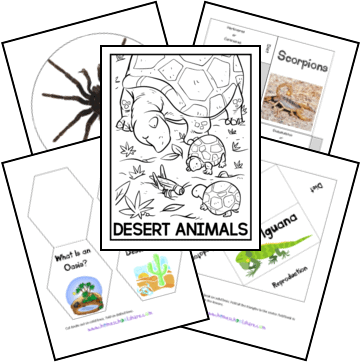
In the Hands of a Child-- Desert Habitats Lapbook
Social Studies: Homes and Houses
Discuss houses with your child. Why do we take shelter in houses? Who made
your home? What was it made out of? What different types of homes are there
around the world? Some live in tents, some live in huts, some live in
igloos. Discuss these different houses with your child if you want after
reading A House is a House for Me by
Mary Ann Hoberman. The house that Alejandro lives in is called an Adobe.
Different Houses
Prepared File (create your own minit book).
Until recent
times most people around the world have built their homes from available natural
resources. In New Mexico, both the Pueblo Indian and Hispanic people have built
their homes with adobe bricks since the Spanish introduced the brick mold. Many
people in New Mexico still build their own homes from this and other materials.
Make a miniature Adobe house
Materials needed in real Adobe making/Materials you will need for your
miniature house
Shovel and hoe, hose and bucket / Hand-held garden hoe and potting shovel
Dirt/Clay (Earth) /Dirt/Clay (Earth)
Straw/Water/Mixing Site /the same (make a sign that says MIXING SITE)
Cardboard Boxes (for molds)/ice cube trays for mini-mold
Rag
Procedure: Adobe Making
1. If wood is not accessible, locate one or two uniformly shaped sturdy cardboard boxes whose tops or bottoms measure approximately 15 x 10-in. Measure 4-in. up from bottom with ruler and draw a line all around box. Take a utility knife and cut along the line. The resulting shallow box will serve as an adobera or adobe mold. Use your ice cube trays for your miniature project or let your older child make his own miniature cardboard molds.
2. Mix earth, straw and water using shovel and hoe in appropriate outdoor site. (Students need to be careful not to mix with hands and shovel or hoe at the same time). Mix to a thick consistency or paste. This is the mud or zoquete. Using your hand-held garden shovel, throw the straw and mud into a large mixing bowl. Use the hoe to mix it up-- or your feet!
3. Lightly wet the inside of the cardboard mold with a wet rag. Pour stiff mud into mold and turn over carefully. Lift mold slowly to release adobe. Allow adobe to dry for three or four days in the sun before handling. They can be turned several times. Put your mixed mud in the ice cube tray. Let it dry in the sun for a few days (until hard) before popping them out.
Building A Wall (*You will need more mud)
1. Take three adobes and lay them in a straight line leaving small gaps between them for mud mortar. Next take three more adobes and lay them perpendicular (at right angles) to the first adobes. Make sure the edges of the two adobes are flush. You should have an L shape. (To determine how many blocks to use for each wall, count your mud blocks and divide by four)
Place mud mortar on the surface of the first level and cross a single adobe from the second row over the first. Place adobes behind the first adobe. The bricks will be naturally staggered through this procedure and students will have built a sturdy corner.
2. Mud plaster the wall by simply wetting the wall with sprinkles of water and then coating it with mud 1/4-in. thick. Smooth it with the palms of your hand.
information and ideas adapted
from
www.nmculturenet.org
Human Relationships: Loneliness
Sometimes people, especially older people, live alone. The feeling of
loneliness can make them feel sad or depressed. Alejandro is busy working
almost all of the time and yet he still felt alone. Sometimes,
someone (like my great-grandmother) has lots of family, but the children,
grand-children, great grandchildren, and even great-great grand children live
far away), and possibly their spouse has passed away. Other older people
who live in a nursing home have these same feelings of loneliness. Maybe
you and your student would like to take a special treat (call first to find out
what would be appropriate) and some homemade cards to a nursing home to help
cheer those who feel alone.
The Old Woman Who Named Things may be a good go-along.
Character Quality: Selflessness
"Even though the animals only came for water, ..."
"He built a second hole even though he wouldn't be able to see them come and
drink..."
Alejandro wasn't selfish at all. Ask your student if he can think of a way
that Alejandro was giving. Alejandro built a well for the animals, but
they didn't come to it because they were afraid. He knew if he built a
second hole that the animals would only come to drink; they wouldn't be coming
for friendship. He knew that he had to build it far away from himself; he
knew that no animal would ever thank him for what he did. Why did he build
the well? He built it because he loved the animals and because he knew it
was a good thing to do. Commend your student this week any time you notice
him being selfless. It is a wonderful Christ-like characteristic to have.
Character Quality/Bible Study: Patience and Perseverance
Many people would've given up after they spent time digging a huge water
hole for the animals. They would consider it the animal's loss; they would
be frustrated and simply say forget it. In what areas does your
student need to persevere?
Alejandro waited days-- even weeks for the animals to
come...he didn't allow his frustration or sadness to hinder him from doing
something wonderful for the animals. In what areas does your student need
to be patient? Waiting can be such a hard thing to do! You can also
discuss waiting on the Lord (to answer a prayer, etc.). You may even want
to have a Bible study comparing/contrasting all the verses that mention waiting
on the Lord, or, you may want to choose one as a memory verse. Here
are some verses you will find in Psalms about waiting on the Lord.
Psalms
27:14
33:20
37:7
37:9
37:34
40:1
59:9
62:1
62:5
69:6
130:5
130:6

Here are some great print-outs to go along with your desert study. You
may want to include some of these items in your lapbook:
Name Desert Birds Print-Out
Picture Scramble Southwest Desert Animals I
Picture Scramble Southwest Desert Animals II
Color Me Southwest Desert Animals
Common Desert Animals Word Find
Funny Sounding Desert Animals Word Find
Desert Flora and Fauna Word Find
Science: Gardening
"Alejandro planted a garden. A garden filled with carrots, beans, and
large brown onions. Tomatoes and corn. Melons, squash, and small red
peppers." What vegetables grow in your area? If the time is
right, consider letting your student plant a small vegetable garden. If it
isn't the right season, plan a vegetable garden on paper. This topic
could also lead into a discussion of vegetables and healthy eating.
If you have more than one student, you can tell them each to pretend
they are a ray and make some of each angle with their bodies on the
floor. (this will take some guidance from teacher! You may
even want to be a ray to demonstrate). To really grasp the idea,
you could draw some huge angles (sidewalk chalk?) and let the rays (your
students) find their places. You can also let them draw
some angles and then measure them with your protractor to determine what
type of angle each one is.
If you have a young child, you may just want to show him what a right
angle is. No matter what age, go searching in your home for right
angles. They are used in construction to make buildings
stand strong. You will find some in every room! You
could even look at the alphabet and determine which letters make right
angles! (E, F, H, L, T, and
I)
How many right angles does each letter have?
Materials and information on this website belong to the
original composers.
It may be used for your own personal and school use.
Material may not be used for resale. © HSS 2005-06